How-To Guides
Supplement Science Glossary: Every Term We Use, Explained
Plain-language definitions for every supplement-science term we use across our reviews, from adaptogen to Trust Score, each linked to where it actually applies.
Disclosure: DigiproSpark may earn a commission if you buy through links on this page, at no extra cost to you. It does not affect our evaluation. Educational content only; not medical advice. See our affiliate disclosure and medical disclaimer.
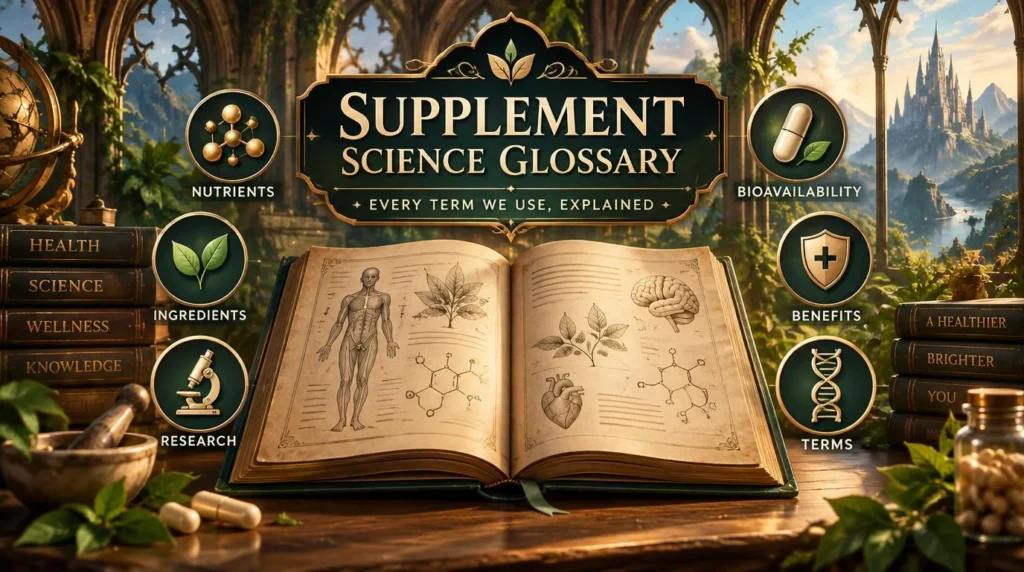
Supplement marketing borrows a lot of real scientific language, adaptogen, bioavailability, clinical trial, meta-analysis, but rarely explains what those words actually mean or how strong the evidence behind them really is. This glossary defines the terms we use most often across our reviews, in plain language, with a link to where each concept actually shows up in our research.
Jump to a term
- Acetylcholinesterase Inhibitor
- Adaptogen
- Antioxidant
- Beta-Glucan
- Certificate of Analysis (COA)
- Bioavailability
- Clinical Trial
- Conditional Verdict
- Critical-Failure Rule
- Dietary Supplement (Regulatory Definition)
- Double-Blind Study
- Evidence Grade (A–U Scale)
- FDA OTC Monograph
- Formula Transparency
- Gamma-Frequency Audio / Brainwave Entrainment
- HbA1c
- Meta-Analysis / Systematic Review
- Nootropic
- Patch Test
- Polyphenol
- Postbiotic
- Prebiotic
- Probiotic
- Proprietary Blend
- Randomized Controlled Trial (RCT)
- Strain-Specificity (Probiotics)
- Thermogenesis
- Trust Score
Acetylcholinesterase Inhibitor
An ingredient or drug that blocks the enzyme (acetylcholinesterase) that normally breaks down the neurotransmitter acetylcholine, leaving more of it active in the brain. Some prescription Alzheimer’s medications work this way, and so does the supplement ingredient Huperzine A, which is why combining a Huperzine A supplement with a related prescription drug needs real medical caution, not a generic “consult your doctor” line.
Adaptogen
A term for a plant or fungal ingredient claimed to help the body “adapt” to physical or mental stress by moderating the stress-hormone response. It’s a real, studied category (ashwagandha is the best-known example) but the effect sizes are generally modest, and “adaptogen” itself isn’t a regulated or precisely defined scientific term.
Antioxidant
A compound that neutralizes free radicals (unstable molecules that can damage cells). Antioxidants are genuinely important to human biology, but “antioxidant supplement” claims are some of the most overstated in the industry: a compound having antioxidant activity in a test tube doesn’t automatically mean a supplement dose produces a measurable health benefit in a person.
Beta-Glucan
A type of complex sugar found in the cell walls of certain mushrooms, oats, and yeast, studied for effects on immune-cell activity. How much beta-glucan a mushroom ingredient actually delivers depends heavily on sourcing: real fruiting-body mushroom extracts run far higher in beta-glucan than mycelium-on-grain products, a distinction most greens-powder labels don’t disclose.
Certificate of Analysis (COA)
A lab report from an independent, third-party testing facility confirming what’s actually in a specific batch of a product, verifying label-claimed ingredient amounts, checking for contaminants (heavy metals, microbes, pesticides), or both. A brand publishing its own in-house testing isn’t the same thing: the value of a COA comes specifically from the lab being independent of the company selling the product. Across the reviews on this site, whether a COA was obtained and shared with us is tracked explicitly in each product’s Quick Facts box, and its absence is stated plainly rather than assumed in the brand’s favor.
Bioavailability
How much of an ingredient actually gets absorbed into your bloodstream and reaches the tissue where it’s supposed to act, as opposed to how much is in the capsule. A compound can have strong laboratory evidence and still underperform in real life if its bioavailability is poor, curcumin is a well-documented example of this gap.
- Quercetin, curcumin & resveratrol: what the combination is actually studied for
- Camu camu and acerola for vitamin C: does “natural” actually absorb better?
Clinical Trial
A study that tests an intervention (a supplement, drug, or other treatment) on real human participants, as opposed to a laboratory (in-vitro) or animal-model study. Not all clinical trials are equally strong: a small, short, non-blinded trial is real evidence but much weaker than a large, blinded, placebo-controlled one. See Randomized Controlled Trial and Double-Blind Study below.
Conditional Verdict
Our own verdict tier for a product whose overall evidence doesn’t clear the bar for an unqualified recommendation, most often because its formula hides ingredient doses inside a proprietary blend. A Conditional verdict isn’t a claim that a product doesn’t work; it’s an honest statement that the available evidence and disclosure don’t support saying that it does.
Critical-Failure Rule
A rule in our own Trust Score system: a product’s Formula Transparency score below a set threshold caps its overall verdict at Conditional, no matter how well it scores on other pillars. This prevents a high average from ever overriding a genuine transparency gap, and it’s the single most common reason a product on this site lands Conditional.
Dietary Supplement (Regulatory Definition)
In the US, a dietary supplement is regulated under a different, lighter framework than a drug: the FDA doesn’t review or approve a supplement’s safety or effectiveness before it reaches the market the way it does for medications. That’s also what makes a proprietary blend legal: labeling rules require the blend’s total weight and ingredient order to be disclosed, but not the amount of each individual ingredient.
Double-Blind Study
A trial design where neither the participants nor the researchers administering the treatment know who is receiving the real product versus a placebo, until after the results are recorded. This is one of the strongest safeguards against bias in human research, a double-blind, placebo-controlled trial is generally considered stronger evidence than an open-label one.
Evidence Grade (A–U Scale)
Our own letter-grade system for how strong the human research behind a specific ingredient claim actually is, from A (strong, consistent, well-replicated human evidence) down toward the lower end of the scale for mechanistic, animal-only, or single-small-study evidence. A proprietary blend caps how high any individual ingredient inside it can be graded, since an undisclosed dose can’t be matched against the dose actually studied.
FDA OTC Monograph
A regulatory list of active ingredients the FDA formally recognizes as safe and effective for a specific over-the-counter use, at a specific concentration. Undecylenic acid, for instance, is a real FDA OTC-monograph-recognized antifungal active, a genuine regulatory fact, though a product still has to actually disclose its concentration for that recognition to mean much to a buyer.
Formula Transparency
One of the five weighted pillars in our own Trust Score: whether a product discloses the exact amount of each active ingredient, or hides some or all of them inside a combined-weight proprietary blend. It’s the single biggest, most consistent factor separating a Conditional verdict from a passing one across every category on this site.
- Proprietary blends explained: why “hidden doses” matter
- Our Review Process: how the Trust Score and verdict tiers work
Gamma-Frequency Audio / Brainwave Entrainment
Sound engineered at a specific frequency (commonly around 40Hz for “gamma”) intended to influence brainwave activity. Real MIT-led research exists on this mechanism, but it’s concentrated in Alzheimer’s-pathology animal models and early human Alzheimer’s trials, a real population mismatch against everyday-focus marketing aimed at healthy adults.
- How to use gamma-frequency audio for focus
- Binaural beats and brainwave entrainment audio: safety, risks, and who should be cautious
HbA1c
A blood test measuring average blood sugar levels over roughly the past two to three months, used in both diabetes diagnosis/management and in supplement research as an outcome measure. When a blood-sugar supplement cites an HbA1c study, checking the actual measured change (and how long the trial ran) tells you far more than the marketing summary does.
- Delphinol maqui berry extract: the real trial behind this blood-sugar ingredient
- Gluco6 & GlucoBerry: blood sugar medication interaction safety
Meta-Analysis / Systematic Review
A study that statistically combines the results of many individual trials on the same question, generally considered stronger evidence than any single trial alone because it averages out the quirks of any one study. A systematic review is the broader literature survey a meta-analysis is often built on. Not every meta-analysis is equally strong, though: the pooled effect can still be driven substantially by one large trial.
- L-Carnitine for fat loss: the real 37-trial meta-analysis
- Moringa oleifera health benefits: what the full 2025 evidence actually shows
Nootropic
A general term for a substance claimed to support cognitive function, memory, or focus. Like “adaptogen,” it’s a marketing-friendly umbrella term, not a regulated or precisely defined one, so a “nootropic” claim tells you nothing about an ingredient’s actual dose, mechanism, or evidence quality on its own.
Patch Test
Applying a small amount of a topical product to a small area of skin and waiting (typically 24–48 hours) to check for an allergic or irritant reaction before applying it more broadly. Genuinely relevant for essential-oil-based topical products: real patch-testing data puts tea tree oil contact-allergy rates at roughly 0.1–3.5%.
Polyphenol
A large family of plant compounds (including catechins, flavonoids, and others) studied for antioxidant and metabolic effects. EGCG, the headline compound in green tea extract, is a polyphenol, real human-trial evidence exists for it, but at specific studied dose ranges that a proprietary blend can obscure.
Postbiotic
A substance produced by probiotic bacteria (such as an enzyme or metabolic byproduct) rather than the live bacteria itself. It’s a related but genuinely different mechanism from a probiotic, and research specifically on postbiotics for a given use (like cavity prevention) is generally newer and thinner than research on live probiotic strains.
Prebiotic
A type of fiber or compound that feeds the beneficial bacteria already living in your gut, as distinct from a probiotic, which supplies live bacteria directly. Many multi-blend greens and gut-health products include a prebiotic blend alongside a separate probiotic blend, each one a distinct place a dose can be disclosed, or hidden.
Probiotic
A supplement or food ingredient containing live microorganisms (usually specific bacterial strains) intended to support gut or oral health. The species name alone (e.g. “Lactobacillus reuteri”) isn’t enough to judge the evidence, different strains of the same species can have very different effects, so the exact strain code matters.
Proprietary Blend
A group of ingredients listed together under one name with a single combined weight, instead of disclosing the amount of each individual ingredient. It’s legal under current labeling rules, but it means a reader has no way to confirm whether any single ingredient inside the blend is present at a dose that matches the research behind it.
Randomized Controlled Trial (RCT)
A study where participants are randomly assigned to either the real treatment or a control (often a placebo), which helps ensure the two groups are comparable and that any measured difference is more likely due to the treatment itself. An RCT is generally stronger evidence than an observational study, and a double-blind RCT is stronger still.
Strain-Specificity (Probiotics)
The principle that a probiotic’s studied effects belong to one exact bacterial strain, not to the whole species. A product listing “Lactobacillus reuteri” in general is making a much weaker implicit claim than one that names and matches the exact strain code (e.g. DSM 17938) used in the actual published trial.
Thermogenesis
The body’s process of generating heat, partly through metabolizing energy, which is why “thermogenic” is used to market weight-loss ingredients claimed to modestly raise calorie burn. Real thermogenic effects from ingredients like green coffee bean extract or L-carnitine are measurable in trials, but the effect sizes are typically modest (roughly one to a few kilograms over weeks to months), not the dramatic results marketing copy often implies.
- Chlorogenic acid (green coffee bean) for weight loss: the real evidence
- L-Carnitine for fat loss: the real 37-trial meta-analysis
Trust Score
Our own transparent, weighted 0–5 rating: Ingredient Evidence, Formula Transparency, Safety, Value & Guarantee, and Brand Trust, each scored individually and combined into one number, with the underlying arithmetic shown on every review page. It replaces a vague pass/fail with a reproducible number anyone can check against the stated math.
Educational content only, not medical advice. Consult a qualified healthcare professional before starting any supplement.
References
- NIH Office of Dietary Supplements: ods.od.nih.gov
- FDA, Dietary Supplement Labeling Guide: fda.gov/food/dietary-supplements
Enjoying our content? Add us as a preferred source on Google.
Add us as a preferred source on GoogleDisclosures
Medical disclaimer
The statements on this page have not been evaluated by the Food and Drug Administration. This product is not intended to diagnose, treat, cure, or prevent any disease. Content is for educational and informational purposes only. Always consult a qualified healthcare professional before starting any new supplement.
Who wrote this
We are not doctors. We are independent researchers who spend dozens of hours analyzing peer-reviewed clinical trials so you don't have to. Every claim on this page is scored against our 5-Point Quality Filter and linked to its source.
Affiliate disclosure
DigiproSpark may earn a commission from purchases made through the affiliate links on this page at no additional cost to you. We only recommend products that pass our 5-Point Quality Filter. Our editorial opinions are not influenced by compensation.

About the author
Satwasheel Gharde
Founder & Head of Research, DigiproSpark
Founder of Smiley Social and Head of Research at DigiproSpark. Personally researches and edits every supplement review here using the 5-Point Quality Filter: transcribing the printed Supplement Facts label, sourcing peer-reviewed human evidence (PubMed / PMC / NIH), and checking clinical dosing before any verdict. Our reviews are evidence-and-label analyses, not medical advice; material safety points (drug interactions, contraindications) are written conservatively and flagged for a qualified clinician or pharmacist to confirm. Conflict-of-interest: pages may contain affiliate links that can earn a commission, which never changes a rating. Corrections & editorial contact: smileysocial@digiprospark.com.
Last updated: August 2, 2026