Safety
Essential Oil Sensitization: What to Know Before Using a Topical Tea Tree Oil Product
Tea tree oil is one of the best-researched natural antifungals for nail and skin use, with real published clinical trial data behind it. It's also a genuine, documented cause of contact allergy in a real, if minority, share of users: a safety point worth understanding in specifics, not just a generic "patch test first" disclaimer, before using a topical product like ProNail Complex or Kerassentials.
Disclosure: DigiproSpark may earn a commission if you buy through links on this page, at no extra cost to you. It does not affect our evaluation. Educational content only; not medical advice. See our affiliate disclosure and medical disclaimer.
Watch
Video Walkthrough
Safety
What to Know Before You Use It
Contact allergy affects a real, documented minority of users
In routine dermatology patch-testing, positive reactions to tea tree oil have been reported at roughly 0.1–3.5% of people tested, depending on the population and study, per a 2016 review in the journal Contact Dermatitis (de Groot, 2016, DOI:10.1111/cod.12591).
Oxidized oil is meaningfully more allergenic than fresh oil
A retrospective review of patch-test data over 4.5 years identified 41 positive reactions among 2,320 people tested (about 1.8%): and found oxidation (from age, heat, or light exposure) specifically increases tea tree oil's allergenic potency (PubMed, PMID 17535193). Store any tea-tree-oil product away from heat and direct light, and don't use it well past any stated expiration.
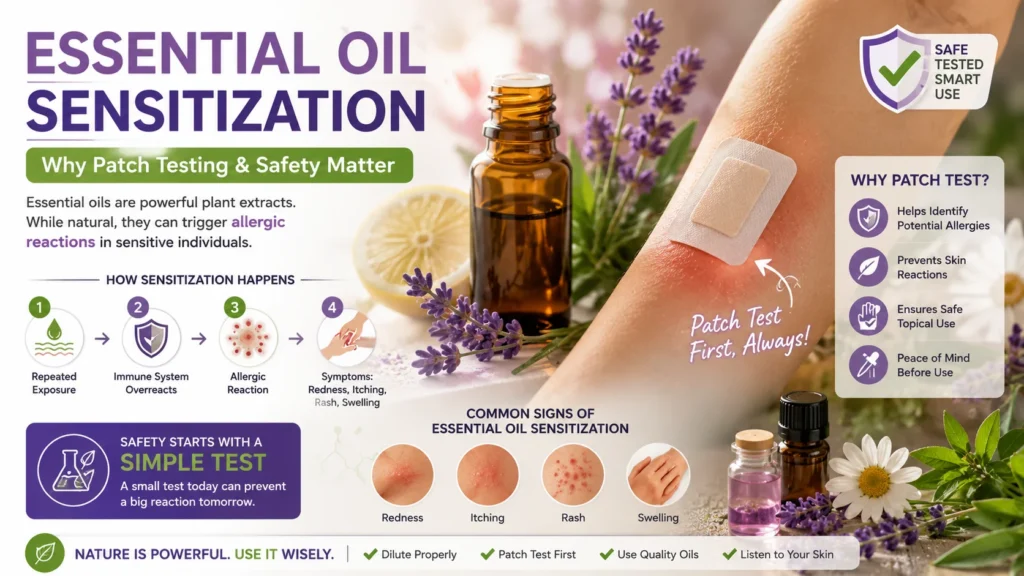
Patch-test on a small area first if you've reacted to any essential oil before
Apply a small amount to an inconspicuous area of skin (like the inner forearm) and wait 24–48 hours before applying it to a larger area or a nail, especially if you have a history of reacting to lavender, eucalyptus, or other essential oils: cross-reactivity between essential oils is a real, documented pattern.
Stop and seek advice for spreading redness, blistering, or worsening pain
These are signs of a true allergic or irritant reaction, not the product "working." Discontinue use and consult a doctor or dermatologist rather than pushing through.
Multiple-oil formulas carry more possible allergens than single-oil ones
A product combining tea tree oil with lemongrass oil and other actives (like a full spray blend) has more individual ingredients that could independently trigger a reaction: worth knowing if you're trying to identify what caused a reaction after the fact.
Diabetes, poor circulation, or a rapidly spreading infection need a podiatrist, not just a topical
A fungal nail infection can sometimes indicate or worsen alongside other conditions that need direct medical evaluation: this applies regardless of which topical product you're using.
What Contact Sensitization Actually Looks Like
Contact allergy to tea tree oil typically presents as redness, itching, small bumps, or mild blistering at the site of application: distinct from the normal, brief tingling some people feel from any topical essential oil, which usually fades within minutes. A true allergic reaction tends to worsen with continued use rather than settling down, and can sometimes spread slightly beyond the exact area of application. It's an immune response to specific compounds in the oil (primarily oxidation breakdown products), not a sign the product is "too strong" or working harder.
The Studies Behind the Numbers
The 0.1–3.5% figure comes from a 2016 review of routine dermatology patch-testing data across multiple studies and populations, the wide range reflects real differences in the patient groups tested (general dermatology patients vs. people specifically referred for suspected cosmetic-product reactions, who test positive far more often). The more specific 1.8% figure comes from a single retrospective review of 2,320 consecutive patch tests at one clinic over 4.5 years, of which 41 were positive for tea tree oil, and only 17 of those 41 (41%) were judged clinically relevant to the person's actual presenting skin condition, a reminder that a positive patch test and a real-world reaction aren't automatically the same thing. Neither of the two founding tea tree oil onychomycosis trials, Buck et al. 1994 or Syed et al. 1999, reported significant allergic reactions among their much smaller participant groups, though neither was designed or powered specifically to measure allergy rates.
Where This Applies to ProNail Complex and Kerassentials
Both ProNail Complex and Kerassentials disclose tea tree oil as a named active ingredient without a stated concentration: meaning neither this cluster nor either pillar review can tell you exactly how much tea tree oil you'd be applying, which also means neither can state your personal allergy risk with precision. The practical guidance is the same for both products: patch-test first, especially if you have any essential-oil sensitivity history, watch for a genuine reaction rather than normal mild tingling, and discontinue if one develops. See our full ProNail Complex vs Kerassentials comparison for how the two products otherwise differ.
Enjoying our content? Add us as a preferred source on Google.
Add us as a preferred source on GoogleDisclosures
Medical disclaimer
This content is for educational purposes only and is not medical advice. It has not been evaluated by the FDA and is not intended to diagnose, treat, cure or prevent any disease. Consult a qualified healthcare professional before starting any supplement.
Who wrote this
We are not doctors. We are independent researchers who spend dozens of hours analyzing peer-reviewed clinical trials so you don't have to. Every claim on this page is scored against our 5-Point Quality Filter and linked to its source.
Affiliate disclosure
DigiproSpark may earn a commission from purchases made through affiliate links on this page at no extra cost to you. It does not change our editorial opinions.

About the author
Satwasheel Gharde
Founder & Head of Research, DigiproSpark
Founder of Smiley Social and Head of Research at DigiproSpark. Personally researches and edits every supplement review here using the 5-Point Quality Filter: transcribing the printed Supplement Facts label, sourcing peer-reviewed human evidence (PubMed / PMC / NIH), and checking clinical dosing before any verdict. Our reviews are evidence-and-label analyses, not medical advice; material safety points (drug interactions, contraindications) are written conservatively and flagged for a qualified clinician or pharmacist to confirm. Conflict-of-interest: pages may contain affiliate links that can earn a commission, which never changes a rating. Corrections & editorial contact: smileysocial@digiprospark.com.
Author of 17 published product reviews on DigiproSpark, each researched under the 5-Point Quality Filter. See the methodology →
Last updated: August 2, 2026