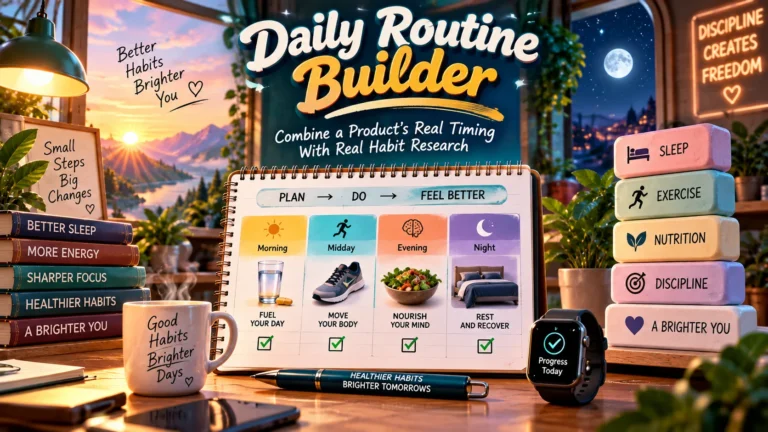
Lifestyle Foundations
Lifestyle Foundations: What Actually Helps You Stick With Any Health Routine
Real, cited research on sleep, exercise, routine, and habit-formation, the factors that actually determine whether any health decision sticks, including taking a supplement consistently.
Disclosure: DigiproSpark may earn a commission if you buy through links on this page, at no extra cost to you. It does not affect our evaluation. Educational content only; not medical advice. See our affiliate disclosure and medical disclaimer.

Every review on this site tells you what a product’s own ingredients and research actually support. None of them can tell you whether you’ll actually take it consistently, sleep enough to let your metabolism function normally, or build the kind of routine that makes any health decision stick. That’s a separate, well-studied question, and this page is where we answer it honestly: with real, cited research, not a fabricated claim that a specific product works better when paired with a specific bedtime.
The honest starting point: no product on this site has been tested alongside a lifestyle protocol
No clinical trial behind Nagano Lean Body Tonic, Gluco6, or anything else we’ve reviewed has tested that product in combination with a specific exercise plan, sleep schedule, or meditation practice. If you see a claim anywhere implying otherwise, including from us, that claim isn’t backed by the same research the product’s own review cites. What follows is real, independently-studied research on sleep, exercise, routine, and habit-formation, each covered on its own honest terms, plus a genuinely useful, separate question: what actually helps a person stick with ANY health routine long enough to know if it’s working.
Sleep: the metabolic factor most routines ignore
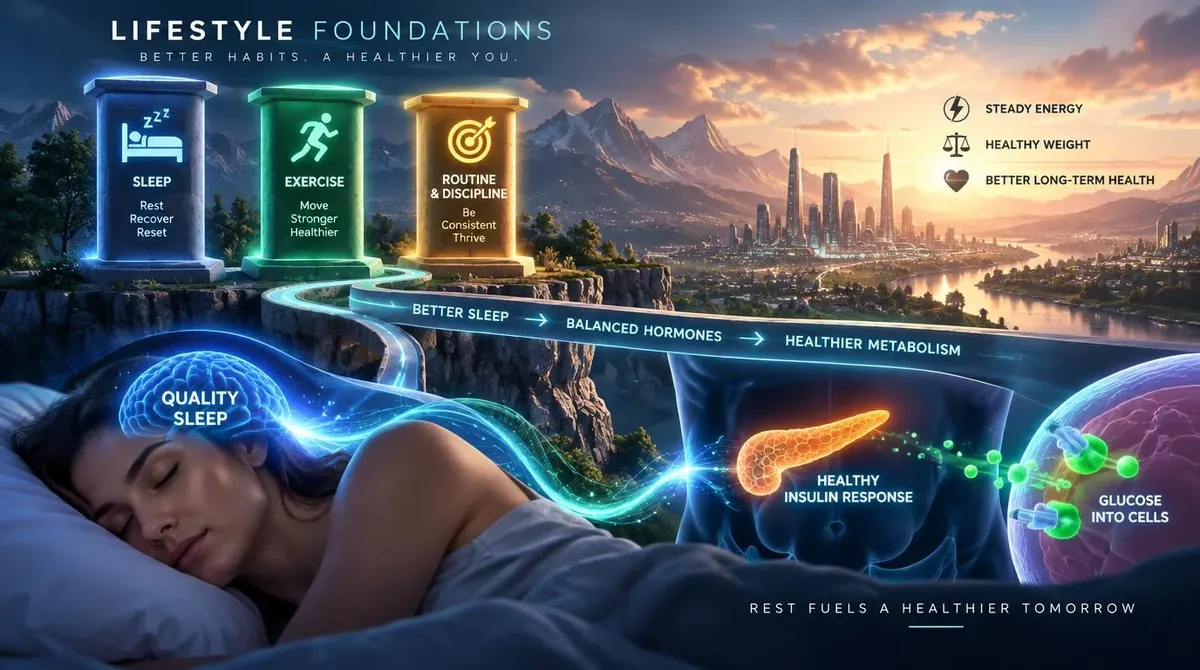
Sleep duration has a real, measured relationship with insulin sensitivity. A study from the EGIR-RISC cohort found sleep duration and insulin sensitivity are linked in a sex-specific way in otherwise healthy people (Rutters et al., 2016), and a separate analysis identified roughly 7 hours 19 minutes as the sleep duration associated with the best insulin sensitivity in its sample, with shorter sleep linked to measurably worse glucose handling. Multiple studies converge on the same broader pattern: short, chronic sleep restriction is associated with reduced insulin sensitivity, increased hunger signaling, and weight gain over time, while even short-term “catch-up” sleep (a few nights of extension) can partially restore insulin sensitivity in people who’d been sleep-restricted.
The practical takeaway has nothing to do with any specific product: if you’re evaluating a blood-sugar-support supplement or a weight-management product and consistently sleeping under 6 hours, the sleep deficit itself is working against the same metabolic system the product is trying to support, independent of whether the product works at all.
Exercise: the other half of the same metabolic picture

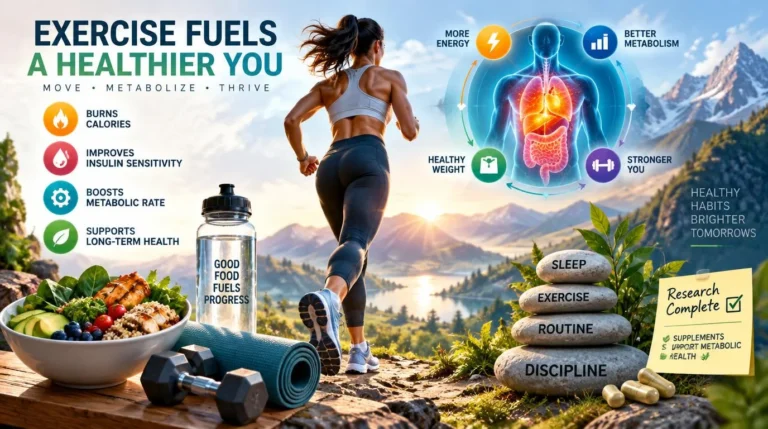
Regular physical activity, both resistance and aerobic training, is well-established in the clinical literature to improve insulin sensitivity, independent of weight loss. This isn’t a single-study finding; it’s foundational enough to be standard guidance from major diabetes and metabolic-health organizations. It matters here for the same reason sleep does: it’s a real, independently-effective lever on the exact systems (blood sugar regulation, metabolic rate) that weight-management and blood-sugar products are marketed toward, and it works whether or not you’re taking anything at all.
Routine and habit-formation: how long it actually takes, and why missing a day doesn’t matter
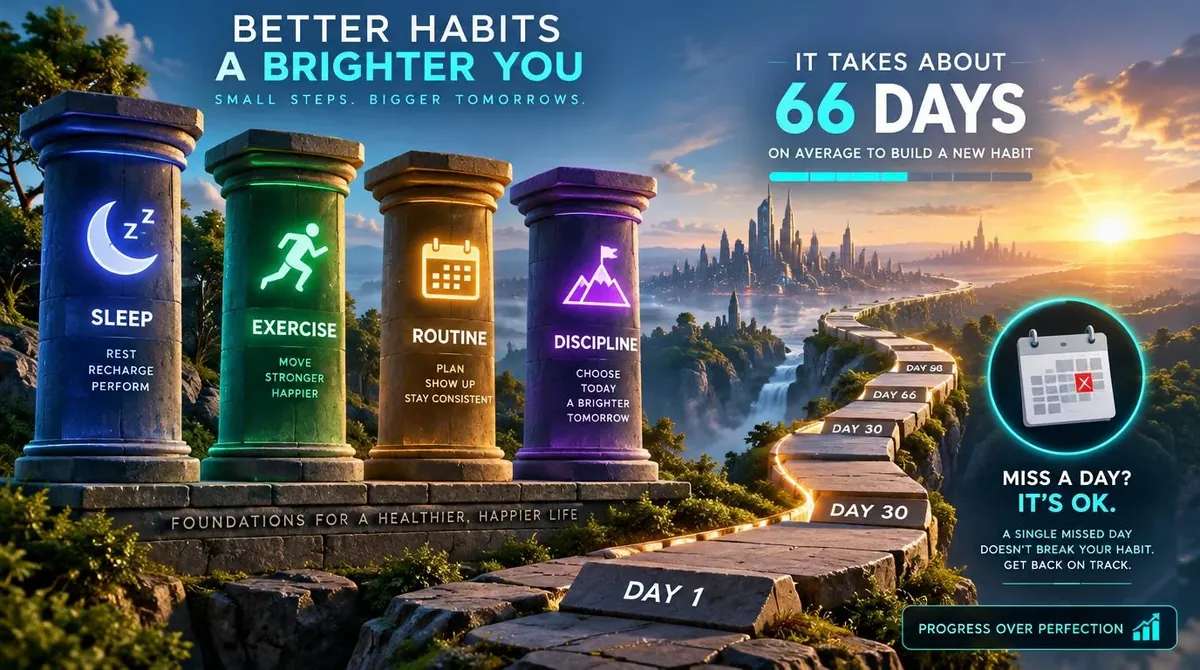
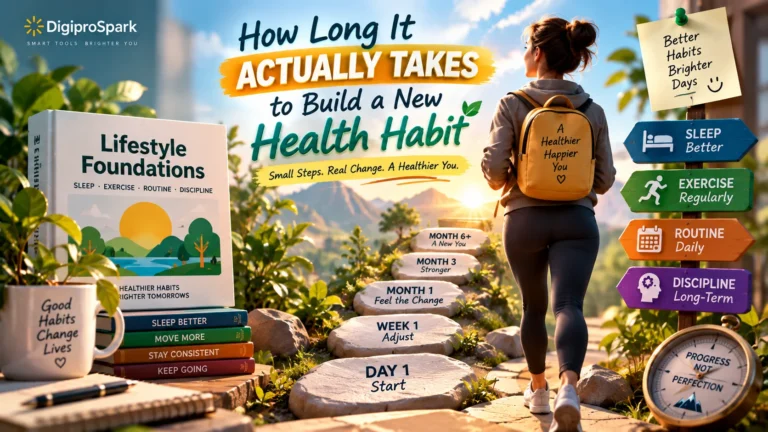
The most-cited real research on how habits actually form comes from Lally et al. (2010, European Journal of Social Psychology): 96 volunteers tracked a new daily behavior for 12 weeks. On average, it took 66 days for the behavior to become automatic, but the real range was enormous, from 18 days to 254 days depending on the person and the behavior. One detail worth remembering if you’ve ever “restarted” a routine after one missed day: the study found that missing a single occasion didn’t meaningfully affect the habit-formation process. The popular “21 days to build a habit” claim doesn’t hold up against this data; the real number is both longer and far more variable.
What this means practically: if you’re starting a new supplement, a 30-day bottle isn’t really a fair trial of whether you can stick with the routine, let alone whether the product works. Expect the habit itself to take longer to feel automatic than a single bottle’s supply, and don’t treat one missed dose as a reason to abandon the routine.
Willpower and discipline: the popular theory that didn’t hold up, and what actually replaced it

For years, “willpower” was widely described as a depletable resource, use it up making one decision and you have less for the next (the “ego depletion” model). This is worth knowing honestly: a large multi-lab replication effort (23 laboratories, over 2,100 participants) failed to replicate the core ego-depletion effect, and an updated meta-analysis correcting for publication bias found the effect statistically indistinguishable from zero. The field doesn’t have a clean, settled answer on why some earlier studies found an effect and this large replication didn’t, but treating willpower as a fixed tank that runs out over the day is no longer something the evidence clearly supports.
What does hold up: implementation intentions, simple “if-then” plans made in advance (Gollwitzer’s research). Deciding “if it’s 8am and I’ve had breakfast, then I take my supplement” ahead of time, while you’re calm and not in the moment of decision, measurably increases the rate people actually follow through, compared to just intending to “remember.” The mechanism isn’t more willpower, it’s removing the need for a fresh decision every single day.
A real way to use all of this together
- Pick one fixed trigger, not a vague intention. “After I brush my teeth” beats “sometime in the morning.”
- Expect the habit to take longer than one bottle to feel automatic. Budget at least 8-9 weeks before judging whether the routine itself has stuck, separate from judging whether the product is working.
- Don’t let one missed day reset your commitment. The actual research on habit formation says it doesn’t meaningfully matter.
- Treat sleep and activity as real, independent levers, not an afterthought to whatever you’re taking. If you’re not addressing them at all, a supplement is working against a real, measurable headwind.
- Use our Dosage & Timing Tool to pick a fixed time that fits your own schedule, the same “if-then” logic the research above describes, applied to a real product’s real label instruction.
Go deeper on each topic
- How Long It Actually Takes to Build a New Health Habit, the full Lally et al. study, explained.
- Sleep and Insulin Sensitivity: What the Real Research Shows.
- Willpower Isn’t a Tank You Empty, what replaced ego-depletion theory.
- Exercise and Metabolic Health: The Real Connection.
What this page is not
This is not a claim that sleep, exercise, or routine-building will make any specific product on this site more effective, that pairing hasn’t been studied for any of them. It’s independently real research on what determines whether people follow through on health decisions generally, offered honestly, on its own terms.
Educational content only, not medical advice. Consult a qualified healthcare professional before starting any new exercise program, sleep intervention, or supplement, especially if you have an existing health condition.
Enjoying our content? Add us as a preferred source on Google.
Add us as a preferred source on GoogleDisclosures
Medical disclaimer
The statements on this page have not been evaluated by the Food and Drug Administration. This product is not intended to diagnose, treat, cure, or prevent any disease. Content is for educational and informational purposes only. Always consult a qualified healthcare professional before starting any new supplement.
Who wrote this
We are not doctors. We are independent researchers who spend dozens of hours analyzing peer-reviewed clinical trials so you don't have to. Every claim on this page is scored against our 5-Point Quality Filter and linked to its source.
Affiliate disclosure
DigiproSpark may earn a commission from purchases made through the affiliate links on this page at no additional cost to you. We only recommend products that pass our 5-Point Quality Filter. Our editorial opinions are not influenced by compensation.

About the author
Satwasheel Gharde
Founder & Head of Research, DigiproSpark
Founder of Smiley Social and Head of Research at DigiproSpark. Personally researches and edits every supplement review here using the 5-Point Quality Filter: transcribing the printed Supplement Facts label, sourcing peer-reviewed human evidence (PubMed / PMC / NIH), and checking clinical dosing before any verdict. Our reviews are evidence-and-label analyses, not medical advice; material safety points (drug interactions, contraindications) are written conservatively and flagged for a qualified clinician or pharmacist to confirm. Conflict-of-interest: pages may contain affiliate links that can earn a commission, which never changes a rating. Corrections & editorial contact: smileysocial@digiprospark.com.
Last updated: October 19, 2026