Safety
Binaural Beats and Brainwave Entrainment Audio: Safety, Risks, and Who Should Be Cautious
Brainwave-entrainment audio, binaural beats, isochronic tones, and similar frequency-based tracks, is generally considered low-risk for most healthy adults, but a few real, specific cautions are worth knowing before you listen, especially if you have a seizure history. Our Genius Song review and Brain Song review both touch on this briefly, this page pulls together the actual research so you can make an informed decision rather than relying on a sales page's blanket reassurance either way.
Disclosure: DigiproSpark may earn a commission if you buy through links on this page, at no extra cost to you. It does not affect our evaluation. Educational content only; not medical advice. See our affiliate disclosure and medical disclaimer.
Watch
Video Walkthrough
Safety
What the safety research actually shows
General safety, for most healthy adults
Binaural beats and brainwave entrainment are generally considered safe when used at a comfortable volume, for reasonable durations, in appropriate settings (not while driving or operating machinery). No major toxicity or physical-harm mechanism applies to audio-only entrainment: unlike a supplement, there's no dose or ingredient interaction to track.
Seizure risk, genuinely lower than flashing light
A high-density EEG study of steady-state binaural-beat stimulation found audio entrainment produces measurably weaker, less synchronized brain-activity effects than visual (flashing-light) entrainment, and there is no clear evidence that binaural beats alone can trigger seizures in the general population. Some limited research even suggests binaural beats may be associated with lower seizure activity in specific contexts, though this isn't established well enough to treat as a therapeutic claim either way.
Who should still be cautious
Anyone with epilepsy or a history of seizures should check with a neurologist before using any frequency-based audio track, particularly ones using higher frequencies (beta, gamma ranges) or containing rapid transitions between frequencies: these are theorized, not proven, to carry somewhat higher risk than steady, low-frequency tones. This is a genuine precaution, not a legal disclaimer written to avoid liability.
Headphone requirement, not just a preference
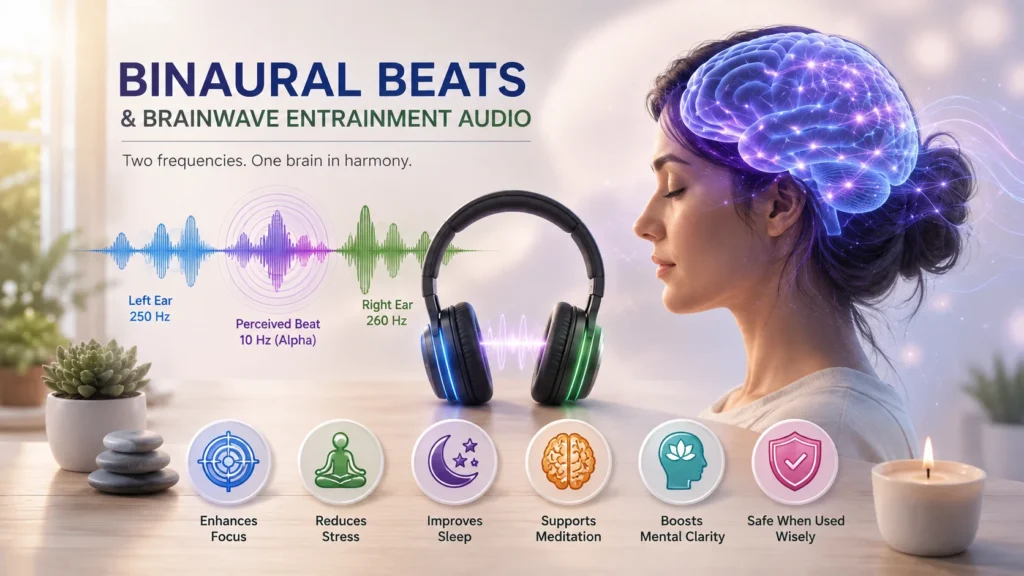
Binaural-beat-specific tracks require stereo headphones: the effect depends on each ear receiving a distinct tone that the brain itself combines into a perceived "beat" at the difference frequency. Speakers don't just weaken the effect, for a true binaural-beat track, they eliminate the core mechanism entirely, since both ears would hear the same mixed signal.
Isochronic tones are a different, headphone-optional mechanism
Isochronic tones (a single tone pulsing on and off at a set rate, rather than two slightly different tones per ear) don't require the same dual-channel separation, so they can work through speakers: worth knowing if a specific product doesn't specify which method it uses.
Not a substitute for medical care
No brainwave-entrainment audio track is a treatment for a diagnosed neurological or psychiatric condition: approach it as an optional wellness experiment, not a therapy, and continue any prescribed treatment exactly as directed regardless of what you try alongside it.
Why audio entrainment is lower-risk than light entrainment
Photosensitive epilepsy, seizures triggered by flashing or strobing light, most famously associated with certain video-game and television incidents, is a well-documented, real phenomenon with a clear, established mechanism: rapid visual flicker can directly drive abnormal, synchronized firing across large areas of the visual cortex in susceptible people. Audio-only entrainment works through an entirely different sensory pathway (auditory processing rather than visual), and a controlled EEG study comparing steady-state binaural-beat stimulation found it produces measurably weaker, less synchronized cortical entrainment than visual stimulation does.
That's a meaningfully different risk profile from a strobing light device, and it's worth not conflating the two even though both technically fall under the broader umbrella term "brainwave entrainment." If you've specifically been told to avoid flashing lights for a photosensitive condition, that caution doesn't automatically transfer one-to-one to an audio-only track, though checking with your neurologist first is still the responsible move given the two aren't fully unrelated.
A practical precaution checklist
If you have any seizure history, talk to a neurologist before trying any frequency-based audio, and mention the specific type (binaural beat vs. isochronic tone) and frequency range if you know it, this level of detail helps a specialist give you an actually useful answer rather than a generic one. If you don't have a seizure history, the main practical precautions are ordinary ones that apply to most audio content: don't listen while driving or operating machinery, especially since some tracks are explicitly designed to induce a relaxed or drowsy state, use a comfortable volume rather than maximizing it for a stronger effect (there's no evidence louder produces a better result, and it adds real hearing-damage risk over time), and stop if you experience any unusual sensation, headache, or dizziness, which isn't an expected or desired response to any legitimate track.
Pregnant listeners, people with a cochlear implant or other implanted electronic device, and people with a diagnosed anxiety or dissociative disorder that flashing/pulsing stimuli have previously triggered should also check with their own clinician first, none of these groups were specifically studied in the entrainment-safety research reviewed above, so an absence of documented risk isn't the same as documented safety for these situations.
Where this applies to The Genius Song and The Brain Song
Both products in our Brain & Focus lineup use frequency-based audio: The Brain Song (a 12-minute track consistently described across sources as gamma-frequency, ~40Hz) and The Genius Song (a 12-minute track targeting theta-frequency, stated plainly on its own official sales page; an earlier version of that review had flagged a labeling inconsistency against some third-party marketing, since resolved: see that review for the full detail). Both carry the same general safety profile described here: low risk for most healthy adults, a genuine but manageable caution for anyone with a seizure history, and a hard requirement for real stereo headphones if the product specifically uses binaural-beat encoding rather than isochronic tones.
Enjoying our content? Add us as a preferred source on Google.
Add us as a preferred source on GoogleDisclosures
Medical disclaimer
This content is for educational purposes only and is not medical advice. It has not been evaluated by the FDA and is not intended to diagnose, treat, cure or prevent any disease. Consult a qualified healthcare professional before starting any supplement.
Who wrote this
We are not doctors. We are independent researchers who spend dozens of hours analyzing peer-reviewed clinical trials so you don't have to. Every claim on this page is scored against our 5-Point Quality Filter and linked to its source.
Affiliate disclosure
DigiproSpark may earn a commission from purchases made through affiliate links on this page at no extra cost to you. It does not change our editorial opinions.

About the author
Satwasheel Gharde
Founder & Head of Research, DigiproSpark
Founder of Smiley Social and Head of Research at DigiproSpark. Personally researches and edits every supplement review here using the 5-Point Quality Filter: transcribing the printed Supplement Facts label, sourcing peer-reviewed human evidence (PubMed / PMC / NIH), and checking clinical dosing before any verdict. Our reviews are evidence-and-label analyses, not medical advice; material safety points (drug interactions, contraindications) are written conservatively and flagged for a qualified clinician or pharmacist to confirm. Conflict-of-interest: pages may contain affiliate links that can earn a commission, which never changes a rating. Corrections & editorial contact: smileysocial@digiprospark.com.
Author of 17 published product reviews on DigiproSpark, each researched under the 5-Point Quality Filter. See the methodology →
Last updated: August 2, 2026