
How-to guide
How to Use Gamma-Frequency Audio for Focus: A Practical, Evidence-Based Guide
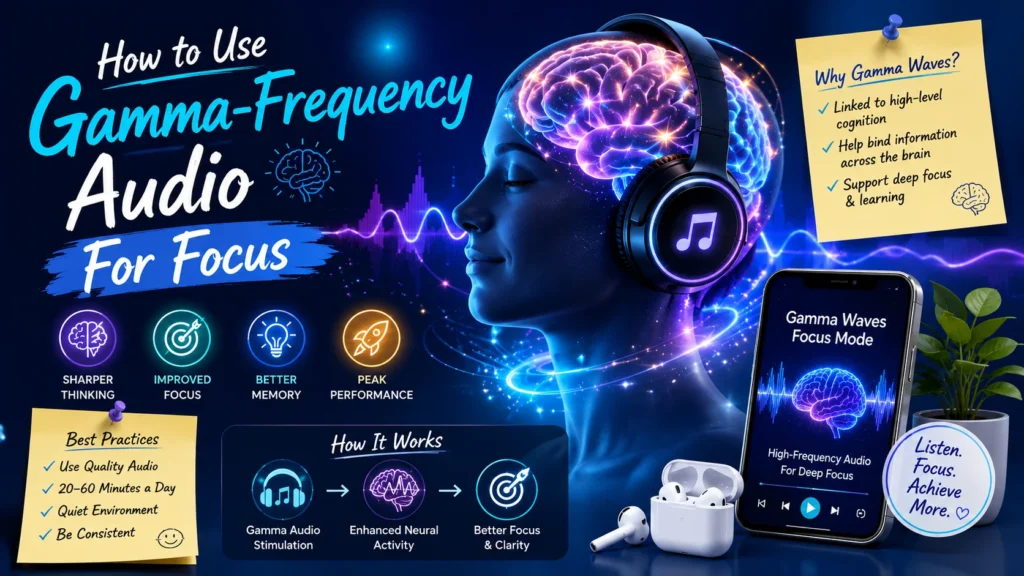
40Hz gamma-frequency audio is one of the more scientifically grounded ideas in the brain-audio space, real, MIT-led research exists, but using it well means understanding what that research actually covers, not just pressing play. Our Brain Song review covers one specific product, this guide focuses on getting the most honest, realistic use out of any gamma-frequency track, whichever one you're trying.
Disclosure: DigiproSpark may earn a commission if you buy through links on this page, at no extra cost to you. It does not affect our evaluation. Educational content only; not medical advice. See our affiliate disclosure and medical disclaimer.
Watch
Video Walkthrough
Step by step
A practical, honest walkthrough
Use real stereo headphones, not speakers
If the track uses binaural-beat-style audio (each ear hearing a slightly different tone), speakers defeat the mechanism entirely: both ears need to hear their separate channel for any entrainment effect to have a chance of working. Cheap earbuds with poor channel separation can have the same problem to a lesser degree.
Listen in a quiet, low-distraction setting
The proposed benefit is a shift toward a more focused brain state: that's harder to notice or benefit from if you're simultaneously multitasking, in a noisy open office, or half-listening to a podcast at the same time. Give the track your actual attention for its full length at least the first few times.
Set realistic expectations from the actual research
The strongest published gamma-frequency research is in Alzheimer's-pathology models, mouse studies and early-stage human Alzheimer's trials from MIT's Tsai lab and collaborators, not healthy-adult focus improvement specifically. One small exploratory pilot study on mood, memory and cognition in a general population did find a benefit, but it carried weak statistical significance. Treat any single listen as a low-cost personal experiment, not a guaranteed or clinically proven effect.
Don't use it as a substitute for sleep or a stimulant replacement
Gamma-frequency audio is not documented to replace the cognitive costs of poor sleep, and it is not a caffeine substitute: treat it as one small, optional input alongside, not instead of, the basics that actually move the needle on focus (consistent sleep, hydration, short breaks, reduced multitasking).
Check with a neurologist first if you have a seizure history
Audio-only entrainment (unlike flashing light) has not been clearly shown to trigger seizures per available research, but higher frequencies like gamma, and rapid frequency shifts, carry a theoretical caution worth a quick conversation with a specialist before you start.
Track your own honest experience over multiple listens, not just one
Because the evidence for healthy-adult benefit is genuinely thin, your own before/after impression, logged consistently across several sessions, not judged after a single listen, is realistically the best information you'll personally have about whether it's doing anything for you specifically. A quick 1-10 focus rating before and after, kept for a week or two, beats a vague impression.
Re-check the source periodically
Gamma-frequency research, particularly the Alzheimer's-focused program, is an active, still-evolving field. What's studied in mouse models today may extend to better-designed healthy-adult human trials in the future: it's reasonable to revisit the evidence occasionally rather than treating today's gap as permanent.
What "40Hz gamma" actually refers to
Gamma waves are a real, fast band of brain electrical activity (roughly 30–100Hz) associated with attention, memory binding and information processing in neuroscience research generally, this isn't a marketing invention, gamma oscillations are a genuinely studied part of normal brain function. "40Hz gamma audio" refers to sound engineered to nudge the brain's own electrical activity toward that specific frequency through a real, documented phenomenon called brainwave entrainment, where external rhythmic stimulation can pull neural oscillations toward matching its rate.
The idea itself isn't pseudoscience, the open, honest question is narrower and more specific: how reliably does a short commercial audio track actually produce measurable 40Hz entrainment in a listener's brain, and, separately, what benefit, if any, does that produce for a healthy adult trying to focus, as opposed to the clinical populations most of the strongest research has actually studied.
The research gap worth knowing about
The most substantial gamma-frequency research program, MIT's Tsai lab and collaborators, has focused specifically on Alzheimer's pathology: 40Hz light and sound stimulation has been shown to reduce amyloid and tau protein markers and preserve cognition in Alzheimer's mouse models, with human Alzheimer's and mild-cognitive-impairment trials now underway to see if the same effect translates. That's a genuinely different population and purpose than "help a healthy 30-year-old focus during a work sprint," even though both get described with the same "40Hz gamma" language.
A separate exploratory pilot study did look at gamma entrainment's effect on mood, memory and cognition more broadly, and found a real improvement, but one with weak statistical significance, the kind of result that's genuinely worth following up on with a larger, more rigorous trial rather than treating as settled. No independent trial of any specific commercial gamma-audio track's effect on healthy-adult focus specifically was identified in our research.
Where this applies to The Brain Song
The Brain Song is a 12-minute downloadable MP3 built around 40Hz gamma audio, delivered instantly by email and backed by a 90-day guarantee enforced directly by ClickBank at the payment-processor level: a genuinely stronger refund structure than a seller-only guarantee, since a refund claim doesn't depend solely on the seller's own responsiveness. See our full Brain Song review for the complete evidence breakdown, including exactly how we weighed the real MIT research against the healthy-adult-focus claim it's actually marketed for, and our honest Conditional verdict.
Enjoying our content? Add us as a preferred source on Google.
Add us as a preferred source on GoogleDisclosures
Medical disclaimer
This content is for educational purposes only and is not medical advice. It has not been evaluated by the FDA and is not intended to diagnose, treat, cure or prevent any disease. Consult a qualified healthcare professional before starting any supplement.
Who wrote this
We are not doctors. We are independent researchers who spend dozens of hours analyzing peer-reviewed clinical trials so you don't have to. Every claim on this page is scored against our 5-Point Quality Filter and linked to its source.
Affiliate disclosure
DigiproSpark may earn a commission from purchases made through affiliate links on this page at no extra cost to you. It does not change our editorial opinions.

About the author
Satwasheel Gharde
Founder & Head of Research, DigiproSpark
Founder of Smiley Social and Head of Research at DigiproSpark. Personally researches and edits every supplement review here using the 5-Point Quality Filter: transcribing the printed Supplement Facts label, sourcing peer-reviewed human evidence (PubMed / PMC / NIH), and checking clinical dosing before any verdict. Our reviews are evidence-and-label analyses, not medical advice; material safety points (drug interactions, contraindications) are written conservatively and flagged for a qualified clinician or pharmacist to confirm. Conflict-of-interest: pages may contain affiliate links that can earn a commission, which never changes a rating. Corrections & editorial contact: smileysocial@digiprospark.com.
Author of 17 published product reviews on DigiproSpark, each researched under the 5-Point Quality Filter. See the methodology →
Last updated: August 2, 2026