How-to guide
When to Take DentaBiome or ProDentim: Does Timing Actually Matter?
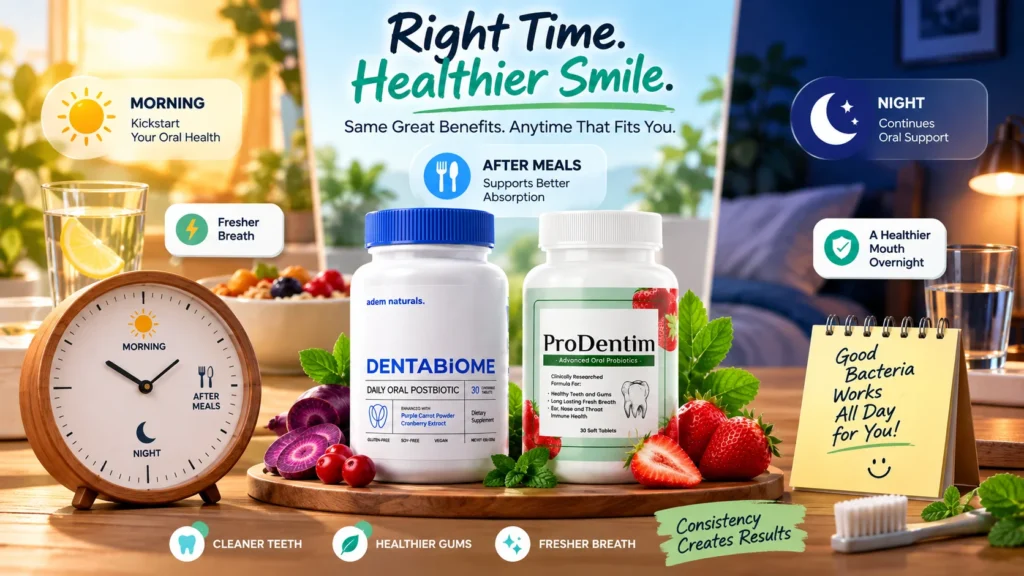
DentaBiome and ProDentim are both oral probiotic/postbiotic supplements meant to be dissolved or chewed rather than swallowed with water: but neither product's own marketing gives much detail on whether timing relative to food actually changes how well they work. We looked at the real research on probiotic strain survival and timing to give an honest answer.
Disclosure: DigiproSpark may earn a commission if you buy through links on this page, at no extra cost to you. It does not affect our evaluation. Educational content only; not medical advice. See our affiliate disclosure and medical disclaimer.
Watch
Video Walkthrough
Step by step
How to Time Either Supplement, Based on the Real Evidence
Understand that this is an oral-cavity product, not a gut-transit one
Unlike a typical swallowed gut probiotic capsule (where stomach-acid survival and intestinal transit timing are major factors), DentaBiome and ProDentim are designed to act in the mouth itself: dissolving or being chewed so the live strains or postbiotic compounds contact teeth and gums directly. This changes what "timing" even means here compared to a standard probiotic.
Follow each product's own stated method exactly
ProDentim is formulated as a slow-dissolving tablet meant to break down in the mouth, DentaBiome's exact delivery format should be confirmed against your own product's label. Using either one as directed (dissolving rather than swallowing whole) matters more than the specific time of day you take it.
Don't assume "empty stomach" is required, because the research doesn't clearly support that for oral-cavity products
Some general probiotic marketing recommends taking capsules on an empty stomach to maximize strain survival through stomach acid: but that concern is specific to products meant to reach and colonize the gut. A product designed to act in the mouth doesn't have the same stomach-acid-survival requirement driving that advice.
Pick a consistent time you'll actually stick to
The clearest, most consistent finding across the general probiotic-timing research is that consistency of use matters more than the specific timing chosen: a supplement taken reliably at a so-so time beats one taken at a theoretically ideal time inconsistently.
Avoid taking either immediately before brushing your teeth
Since both products are meant to let live strains or active compounds interact with your oral environment, brushing (and any accompanying mouthwash) immediately afterward could wash away or disrupt that contact time before it has a chance to work: space them apart by at least a few minutes.
What the Actual Research on Probiotic Timing Shows
A well-known study on Lactobacillus rhamnosus GG (one of the most-studied probiotic strains, though not necessarily the exact strain in either DentaBiome or ProDentim) looked at survival relative to food intake and found genuinely mixed results across different conditions: there's no clear scientific consensus that taking a probiotic strictly before, with, or after food produces a meaningfully different outcome for most formulations. This honestly undercuts a lot of confident-sounding timing advice sold alongside probiotic products generally. For an oral-cavity-acting product specifically, the food-timing question is even less directly relevant than it is for a swallowed gut probiotic, since the mechanism of action doesn't primarily depend on surviving stomach transit.
Why Consistency Beats Precision Here
Given the genuinely inconclusive evidence on optimal timing, the most defensible, honest recommendation is that consistency of daily use is probably more important than the specific timing relative to food. This matches the broader pattern in supplement adherence research: a product taken reliably every day at a merely reasonable time will likely outperform one taken at a theoretically optimized time but skipped half the days. If you want a science-backed opinion on either product's actual formula, see our full DentaBiome review and ProDentim review, including the specific evidence gaps each carries.
A Practical Routine That Fits Either Product
A reasonable, low-effort routine: take your chosen product once daily, at roughly the same time each day, at least a few minutes before brushing your teeth so the strains or compounds have some uninterrupted contact time with your mouth. Don't overthink whether that's morning or night, or whether you've eaten recently: the research doesn't give a strong enough signal either way to justify the mental overhead of optimizing it further. If you're using DentaBiome specifically, also review its xylitol dosing guide, since xylitol's cavity-prevention timing (spread across multiple daily exposures) is a genuinely different, better-evidenced timing question than the probiotic-strain question this guide addresses.
Enjoying our content? Add us as a preferred source on Google.
Add us as a preferred source on GoogleDisclosures
Medical disclaimer
This content is for educational purposes only and is not medical advice. It has not been evaluated by the FDA and is not intended to diagnose, treat, cure or prevent any disease. Consult a qualified healthcare professional before starting any supplement.
Who wrote this
We are not doctors. We are independent researchers who spend dozens of hours analyzing peer-reviewed clinical trials so you don't have to. Every claim on this page is scored against our 5-Point Quality Filter and linked to its source.
Affiliate disclosure
DigiproSpark may earn a commission from purchases made through affiliate links on this page at no extra cost to you. It does not change our editorial opinions.

About the author
Satwasheel Gharde
Founder & Head of Research, DigiproSpark
Founder of Smiley Social and Head of Research at DigiproSpark. Personally researches and edits every supplement review here using the 5-Point Quality Filter: transcribing the printed Supplement Facts label, sourcing peer-reviewed human evidence (PubMed / PMC / NIH), and checking clinical dosing before any verdict. Our reviews are evidence-and-label analyses, not medical advice; material safety points (drug interactions, contraindications) are written conservatively and flagged for a qualified clinician or pharmacist to confirm. Conflict-of-interest: pages may contain affiliate links that can earn a commission, which never changes a rating. Corrections & editorial contact: smileysocial@digiprospark.com.
Author of 17 published product reviews on DigiproSpark, each researched under the 5-Point Quality Filter. See the methodology →
Last updated: August 2, 2026