
How-to guide
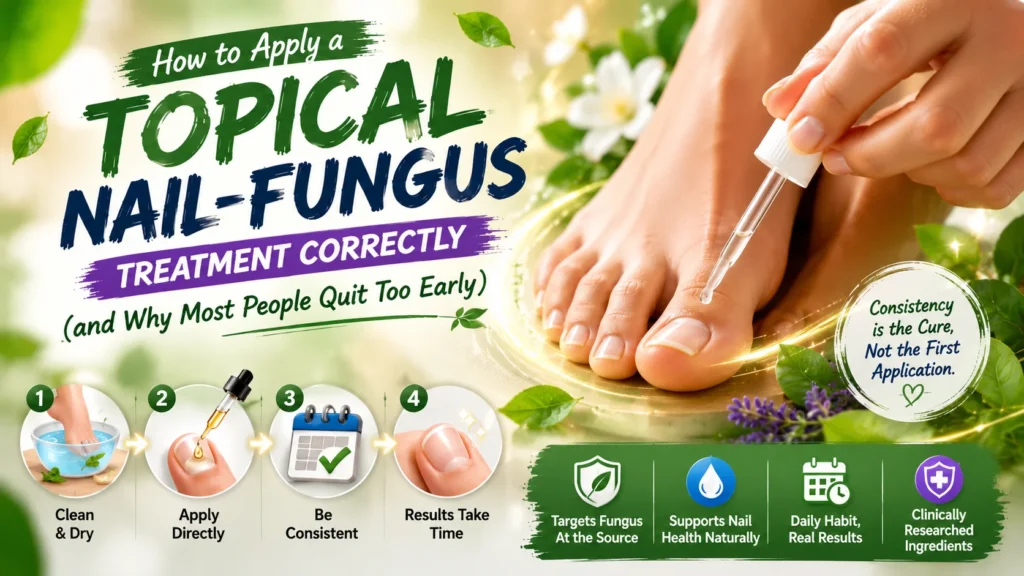
How to Apply a Topical Nail-Fungus Treatment Correctly (and Why Most People Quit Too Early)
A topical antifungal, whether a spray like ProNail Complex or an oil like Kerassentials, can only work if it's actually applied consistently and given enough time. Nail fungus (onychomycosis) treatments fail far more often from stopping too early than from the active ingredients themselves being ineffective. Here's what the actual clinical trial protocols behind tea tree oil and undecylenic acid did, and what that means for using any topical product correctly.
Disclosure: DigiproSpark may earn a commission if you buy through links on this page, at no extra cost to you. It does not affect our evaluation. Educational content only; not medical advice. See our affiliate disclosure and medical disclaimer.
Watch
Video Walkthrough
Step by step
Step by Step
Wash and thoroughly dry your feet and nails first
Trapped moisture is exactly the environment nail fungus favors: applying a topical over damp skin dilutes it and works against you before you've even started.
Trim and file down the thickened nail surface when you can
Onychomycosis-thickened nail tissue acts as a physical barrier. Filing the top layer down (a nail file or emery board, cleaned between uses) lets a topical actually reach the fungus living under and within the nail, rather than sitting on top of a barrier it can't penetrate: a real, practical reason topical-only treatments often underperform prescription oral antifungals in head-to-head studies.
Apply directly to the nail plate, cuticle, and the skin just around it
Most published trials and brand instructions apply the product to the whole nail unit, not just the visibly discolored tip, since the fungus is typically present under healthy-looking nail as well as the obviously affected part.
Let it fully absorb before covering with socks or shoes
Sealing a topical under an occlusive layer before it's absorbed can trap moisture against the nail: the opposite of the dry environment fungus dislikes.
Apply consistently, once or twice daily, for months: not weeks
This is the step most people get wrong. The foundational Buck et al. 1994 tea tree oil trial ran twice-daily application for a full 6 months before reporting its roughly 60% clinical-improvement figure. A fingernail takes about 6 months to fully regrow, a big toenail can take 12–18 months. No topical, including prescription ones, can out-pace how fast a new, clear nail physically grows in.
Track progress at the new growth near the cuticle, not the old discolored tip
The part of the nail closest to the cuticle is the newest growth: clear, healthy nail appearing there over weeks and months is the real sign of progress. The old discolored tip won't change color, it has to grow out and eventually be trimmed away.
Know when a topical alone isn't enough
Diabetes, poor circulation, or a rapidly spreading infection are all reasons to see a podiatrist rather than relying on a topical alone: a fungal nail infection can sometimes indicate or worsen alongside other conditions that need direct medical evaluation.
Why Consistency Matters More Than the Product Itself
Every topical nail-fungus product on the market, prescription or over-the-counter, is bound by the same biological constraint: a nail can only be fully replaced by new, fungus-free growth, and that growth happens at a fixed, slow rate, roughly 3mm/month for fingernails, roughly 1–1.5mm/month for toenails. No topical formula changes that timeline, a product can only give the new growth the best chance of coming in clear. This is why the clinical trials with the clearest positive signal for tea tree oil (Buck et al. 1994, PubMed) and undecylenic acid (recognized under an FDA OTC antifungal monograph) both ran for months, not days or weeks, and why stopping a real product after two or three weeks because "nothing's happening yet" is one of the most common, avoidable reasons a topical treatment gets written off as not working.
What “Working” Actually Looks Like, Week by Week
Realistic expectations, based on the published trial timelines rather than marketing copy: weeks 1–4, expect no visible change: this is normal, not a sign of failure. Around months 1–2, some people notice the nail texture becoming slightly less brittle or the surface less rough, though this is subjective and not something every trial measured. The first objectively visible sign is usually new, clear nail growth emerging at the cuticle over months 2–4. Full replacement of a fully affected toenail realistically takes 6–12+ months.
When a Topical Alone Isn't Enough
Topicals like ProNail Complex and Kerassentials are reasonable first steps for early or mild infections, but they're not the only option, and they're not always sufficient. Prescription oral antifungals (terbinafine, itraconazole) generally show higher cure rates in comparative studies than topical-only treatment, at the cost of requiring liver-function monitoring and carrying their own interaction/side-effect profile: a real trade-off, not a reason to avoid either option outright. See our full ProNail Complex vs Kerassentials comparison for how the two topical options stack up against each other specifically, and talk to a podiatrist if you have diabetes, poor circulation, or an infection that's spreading rather than slowly improving.
Enjoying our content? Add us as a preferred source on Google.
Add us as a preferred source on GoogleDisclosures
Medical disclaimer
This content is for educational purposes only and is not medical advice. It has not been evaluated by the FDA and is not intended to diagnose, treat, cure or prevent any disease. Consult a qualified healthcare professional before starting any supplement.
Who wrote this
We are not doctors. We are independent researchers who spend dozens of hours analyzing peer-reviewed clinical trials so you don't have to. Every claim on this page is scored against our 5-Point Quality Filter and linked to its source.
Affiliate disclosure
DigiproSpark may earn a commission from purchases made through affiliate links on this page at no extra cost to you. It does not change our editorial opinions.

About the author
Satwasheel Gharde
Founder & Head of Research, DigiproSpark
Founder of Smiley Social and Head of Research at DigiproSpark. Personally researches and edits every supplement review here using the 5-Point Quality Filter: transcribing the printed Supplement Facts label, sourcing peer-reviewed human evidence (PubMed / PMC / NIH), and checking clinical dosing before any verdict. Our reviews are evidence-and-label analyses, not medical advice; material safety points (drug interactions, contraindications) are written conservatively and flagged for a qualified clinician or pharmacist to confirm. Conflict-of-interest: pages may contain affiliate links that can earn a commission, which never changes a rating. Corrections & editorial contact: smileysocial@digiprospark.com.
Author of 17 published product reviews on DigiproSpark, each researched under the 5-Point Quality Filter. See the methodology →
Last updated: August 2, 2026