Safety
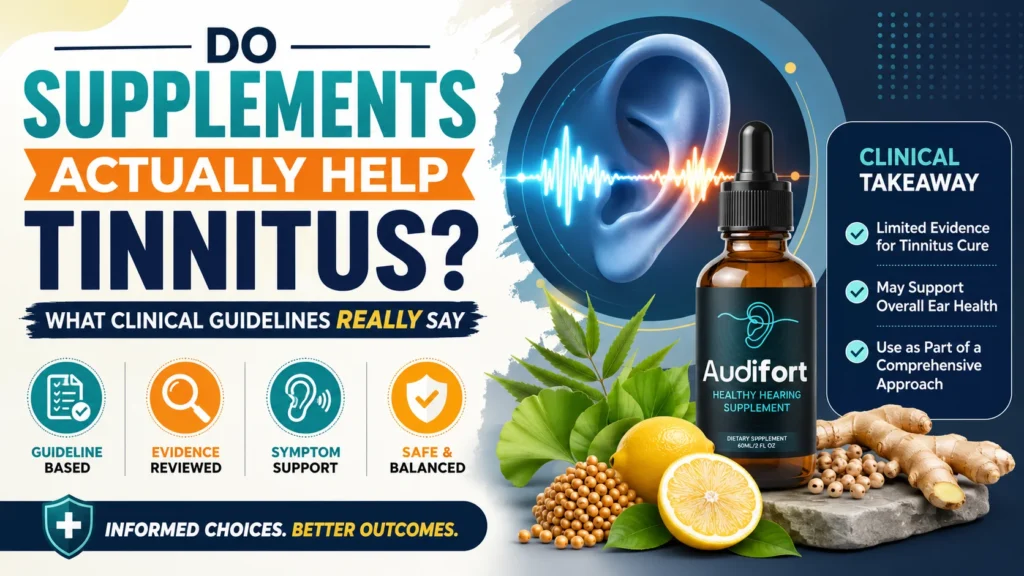
Do Supplements Actually Help Tinnitus? What Clinical Guidelines Really Say
If you're researching supplements for tinnitus (ringing, buzzing or hissing in the ears with no external sound source), the single most useful thing to know is what the actual clinical practice guideline says: not what a sales page claims. Our Audifort review and ZenCortex review each check a specific product against this guideline, this page explains the guideline itself in full, including why it exists, what it does and doesn't rule out, and what the actual evidence-based path forward looks like.
Disclosure: DigiproSpark may earn a commission if you buy through links on this page, at no extra cost to you. It does not affect our evaluation. Educational content only; not medical advice. See our affiliate disclosure and medical disclaimer.
Watch
Video Walkthrough
Safety
What the clinical guideline actually says
The core recommendation
The American Academy of Otolaryngology-Head and Neck Surgery Foundation's Clinical Practice Guideline: Tinnitus (Tunkel et al., 2014, Otolaryngology-Head and Neck Surgery) states clinicians should NOT recommend dietary supplements, including ginkgo biloba, melatonin, and zinc, for treating patients with persistent, bothersome tinnitus. This is a formal, evidence-graded recommendation from a national medical specialty society, not an informal opinion.
Why even the best-studied options failed
Ginkgo biloba is the most-studied tinnitus supplement by a wide margin. A 2022 Cochrane systematic review of 12 randomized controlled trials (1,915 participants total) concluded ginkgo "may have little to no effect" on tinnitus, rating the certainty of that evidence as very low. Zinc performed no better than placebo in a randomized, double-blind, placebo-controlled trial in elderly patients with tinnitus. Melatonin's evidence is similarly limited to small, mixed-quality trials.
What this means for less-studied ingredients
If ginkgo, zinc and melatonin, the three most-researched tinnitus supplement candidates, each with real published RCT data, still don't clear the bar for a clinical recommendation, an ingredient with NO direct hearing- or tinnitus-outcome trial behind it at all starts from a materially weaker evidence position, regardless of how confidently it's marketed.
How guideline committees actually grade evidence
Clinical practice guidelines like this one use structured evidence-grading systems (commonly GRADE) that weigh study design, sample size, consistency across trials, and risk of bias: not just whether a study exists. A single small, uncontrolled trial showing a positive result carries far less weight than several well-designed RCTs, even if a product's marketing cites the small study prominently.
What the guideline recommends instead
Evidence-based tinnitus management options include sound therapy (background or masking noise), cognitive behavioral therapy (CBT) to reduce the distress and attention tinnitus attracts, hearing aids where hearing loss coexists with tinnitus (which is common), and identifying and addressing underlying contributing factors: ototoxic medication side effects, earwax blockage, noise-induced damage, or an underlying medical condition.
When to see a professional
Any new, persistent, or worsening tinnitus, especially if it's in one ear only, pulsing in rhythm with your heartbeat, or accompanied by hearing loss, dizziness, or pain, warrants an audiologist or ENT evaluation to rule out a treatable underlying cause before trying any supplement-based approach on your own. Sudden hearing loss specifically is a medical urgency, see the AAO-HNSF sudden hearing loss guideline for what warrants immediate evaluation.
Why a clinical guideline carries more weight than a product review
Individual product reviews, including ours, can tell you whether a specific formula's named ingredients have real research behind them for a general purpose. A clinical practice guideline is a different, stronger kind of evidence entirely: it represents a formal committee process where a medical specialty society (in this case, the American Academy of Otolaryngology-Head and Neck Surgery Foundation) systematically reviews every available trial on a topic, grades its quality, and issues a formal recommendation. When that recommendation explicitly advises AGAINST an entire category, dietary supplements, broadly, for tinnitus, that's a stronger, more comprehensive signal than any single product's citations, however credible those individual citations look in isolation.
This matters practically: a supplement marketing page can cite one real, genuine study and never mention the guideline that reviewed that same body of evidence and reached a cautious or negative conclusion overall. Both things can be true at once, the cited study is real, and the category-wide guideline still says the evidence isn't strong enough to recommend.
This isn't the same as "nothing can help"
The guideline's recommendation against supplements sits alongside real, evidence-based options that DO have genuine clinical trial support: sound therapy (using background or masking noise to make tinnitus less noticeable, particularly helpful for sleep), cognitive behavioral therapy (addressing the distress and attentional focus tinnitus creates, often the single most disruptive part of the condition, independent of the sound's actual loudness), and hearing aids when hearing loss coexists with tinnitus, which it frequently does since both often share the same underlying cause (age- or noise-related cochlear damage).
An audiologist or ENT visit can also identify a treatable underlying cause a supplement has no mechanism to address at all: certain medications are ototoxic and can cause or worsen tinnitus as a side effect, earwax impaction can cause or amplify perceived tinnitus and is fixed in one office visit, and some cases trace to a specific, diagnosable ear condition. None of these paths require guessing, they start with an actual hearing evaluation.
Where this applies to Audifort and ZenCortex
We checked Audifort's specific ingredient list, maca root, grape seed extract, green tea, capsicum annuum, gymnema sylvestre, and GABA, against this exact guideline before writing anything else in our review. None of them have direct hearing- or tinnitus-outcome trial support identified, a materially weaker evidence position than even the guideline's own already-reviewed-and-rejected comparators (ginkgo, zinc, melatonin). One ingredient, GABA, carries an additional mechanistic problem: its marketed claim depends on crossing into the brain from an oral dose, and whether oral GABA meaningfully crosses the blood-brain barrier is itself scientifically disputed, independent of any tinnitus-specific question.
We applied the same check to ZenCortex's 20+ ingredient blend and reached the same conclusion, no ingredient has direct tinnitus- or hearing-outcome trial support. ZenCortex adds its own separate problem on top: it names only 8 ingredients on its official sales page while claiming "over 20" total, a real transparency gap beyond the shared evidence problem.
See our full Audifort review and ZenCortex review for the complete ingredient-by-ingredient breakdowns, the full Trust Score calculations, and our Not Recommended verdicts, the only two products in our entire review catalog to land in that tier, both driven specifically by this evidence gap rather than any acute safety concern with the ingredients themselves. See also our direct Audifort vs ZenCortex comparison.
Enjoying our content? Add us as a preferred source on Google.
Add us as a preferred source on GoogleDisclosures
Medical disclaimer
This content is for educational purposes only and is not medical advice. It has not been evaluated by the FDA and is not intended to diagnose, treat, cure or prevent any disease. Consult a qualified healthcare professional before starting any supplement.
Who wrote this
We are not doctors. We are independent researchers who spend dozens of hours analyzing peer-reviewed clinical trials so you don't have to. Every claim on this page is scored against our 5-Point Quality Filter and linked to its source.
Affiliate disclosure
DigiproSpark may earn a commission from purchases made through affiliate links on this page at no extra cost to you. It does not change our editorial opinions.

About the author
Satwasheel Gharde
Founder & Head of Research, DigiproSpark
Founder of Smiley Social and Head of Research at DigiproSpark. Personally researches and edits every supplement review here using the 5-Point Quality Filter: transcribing the printed Supplement Facts label, sourcing peer-reviewed human evidence (PubMed / PMC / NIH), and checking clinical dosing before any verdict. Our reviews are evidence-and-label analyses, not medical advice; material safety points (drug interactions, contraindications) are written conservatively and flagged for a qualified clinician or pharmacist to confirm. Conflict-of-interest: pages may contain affiliate links that can earn a commission, which never changes a rating. Corrections & editorial contact: smileysocial@digiprospark.com.
Author of 17 published product reviews on DigiproSpark, each researched under the 5-Point Quality Filter. See the methodology →
Last updated: August 2, 2026