
Ingredient disclosure • Clinical guidance • Safety • Price • Refund terms • Honest verdict
Audifort Review 2026: Ingredients, Evidence & Honest Verdict
This Audifort review is evidence-first, and it leads with the single most important fact we found: the American Academy of Otolaryngology's own clinical practice guideline explicitly recommends against dietary supplements for tinnitus. We checked Audifort's specific ingredients against real research, not just the sales page, before writing anything else.
Disclosure: DigiproSpark may earn a commission if you buy through links on this page, at no extra cost to you. It does not affect our evaluation. Educational content only; not medical advice. See our affiliate disclosure and medical disclaimer.
The short answer
Trust Score 2.2/5 · Not Recommended
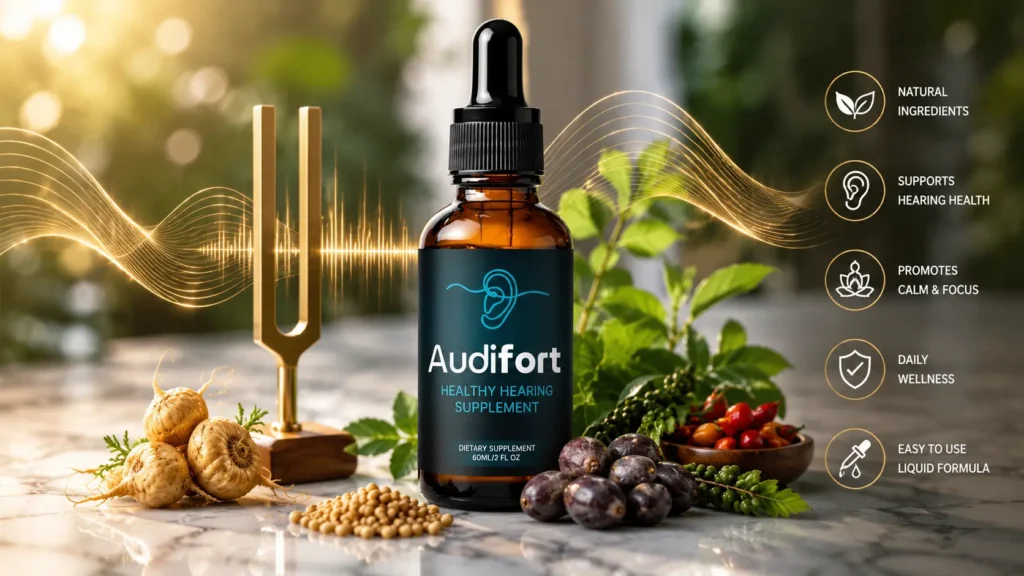
Audifort is a liquid drops supplement marketed for hearing support and tinnitus (ringing in the ears) relief, built around 20+ plant-based ingredients including maca root, grape seed extract, green tea, capsicum and GABA. The single most important thing to know: the American Academy of Otolaryngology-Head and Neck Surgery's clinical practice guideline explicitly states clinicians should NOT recommend dietary supplements for persistent tinnitus, and no supplement has demonstrated reliable efficacy for it in peer-reviewed trials: a standard even the most-studied supplements (ginkgo, zinc, melatonin) fail to meet. None of Audifort's specific ingredients are among even those already-studied-and-rejected options. We give it a Not Recommended verdict for its core hearing/tinnitus claim.
- Supplement Facts label photo
- Formula and dose info on file
- Per-ingredient evidence + citations
- Verified price, serving & guarantee facts
- Refund / guarantee terms
- Safety, interactions & contraindications
- Frequently asked questions
“Documented” means this information is on file and cited — not that we independently authenticated it against a purchased, physical product. Where a specific fact couldn’t be confirmed that way, the review says so directly.
Audifort scores 2.2/5 on the DigiproSpark Trust Score (Not Recommended). Its strongest check is Safety & Tolerability at 3.2/5 and its weakest is Ingredient Evidence at 0.8/5. The score is a weighted average of five checks, and the full arithmetic is shown below.
A weighted score across five checks. Each is rated out of 5; the weights (shown as %) reflect how much each matters for a buying decision. See our full method →
The AAO-HNS clinical practice guideline explicitly recommends against dietary supplements for tinnitus, stating none has demonstrated reliable efficacy in peer-reviewed trials: a bar even ginkgo, zinc and melatonin (the most-studied options) don't clear. None of Audifort's specific ingredients (maca, grape seed, green tea, capsicum, GABA, gymnema) are among even those already-tested-and-rejected supplements.
The label names 20+ ingredients, but we could not find specific per-ingredient amounts in any source available to us: a real transparency gap on top of the evidence gap.
Most named ingredients (maca, grape seed extract, green tea, gymnema) have a generally mild safety profile at typical doses. GABA's actual ability to cross the blood-brain barrier from an oral dose is scientifically disputed: worth knowing since it undercuts the "calms the auditory cortex" mechanism claimed for it.
The 90-day return window is counted from your purchase date, not your delivery date: a real, easy-to-miss detail that shortens the effective window if shipping takes any real time. Per-bottle pricing is broadly in line with competing liquid supplements, but paying for a product explicitly advised against by clinical guidelines for its main marketed use is a real value concern regardless of price.
Sold across numerous similar-looking domains, a pattern common to affiliate-funnel supplements generally, we found no independently confirmed named formulator or third-party lab results.
See the calculation
(0.8×25%) + (2.0×20%) + (3.2×20%) + (2.8×20%) + (2.6×15%) = 2.19 → 2.2/5
Quick summary
Audifort at a Glance
People who want to understand what real clinical guidance says about supplements and tinnitus before spending money, and who are looking at Audifort specifically as a general wellness product rather than a hearing treatment.
Anyone with persistent, bothersome tinnitus looking for an evidence-based treatment: see a doctor or audiologist instead, per the clinical guideline discussed throughout this review. Also not ideal for anyone expecting a hearing-restoration effect, pregnant or nursing women, or anyone under 18.
If you have persistent or bothersome tinnitus, the single most useful next step is an audiologist or ENT visit, not a supplement: that's what the actual clinical guideline recommends. If you're still interested in Audifort as a general wellness product, go in knowing its core hearing/tinnitus claim has no ingredient-specific research behind it.
This content is for information only and is not medical advice, diagnosis or treatment. Tinnitus and hearing changes should be evaluated by a doctor or audiologist. Consult a qualified healthcare professional before starting any supplement, especially with a medical condition, medication, pregnancy or nursing.
Watch the review
Video Walkthrough
A video walkthrough of the real clinical guidance on tinnitus supplements and what we found researching Audifort specifically is planned: coming soon.
Overview
What Is Audifort?
Audifort is a liquid drops supplement marketed for hearing support and tinnitus relief, taken under the tongue or in water. The label names 20+ plant-based ingredients, including maca root, grape seed extract, green tea, capsicum annuum, gymnema sylvestre and GABA. It is positioned in our Brain & Focus category per the product roster it's grouped under, though its own marketing targets hearing and tinnitus specifically.
Before covering its ingredients, the single most load-bearing fact for this review: the American Academy of Otolaryngology-Head and Neck Surgery's clinical practice guideline on tinnitus explicitly states clinicians should NOT recommend dietary supplements, including the most-studied options, ginkgo biloba, zinc and melatonin, because none has demonstrated reliable efficacy in peer-reviewed trials. Audifort's specific formula is not among even those already-tested-and-rejected supplements.
Mechanism
How Audifort Is Marketed to Work vs What's Actually Been Studied
The marketing describes specific physiological mechanisms for several ingredients: "protects the auditory system," "enhances blood circulation to the ear," "calms auditory-cortex hyperexcitability." These are plausible-sounding but largely untested claims for this exact use, and one of them (GABA crossing into the brain) runs into real scientific dispute.
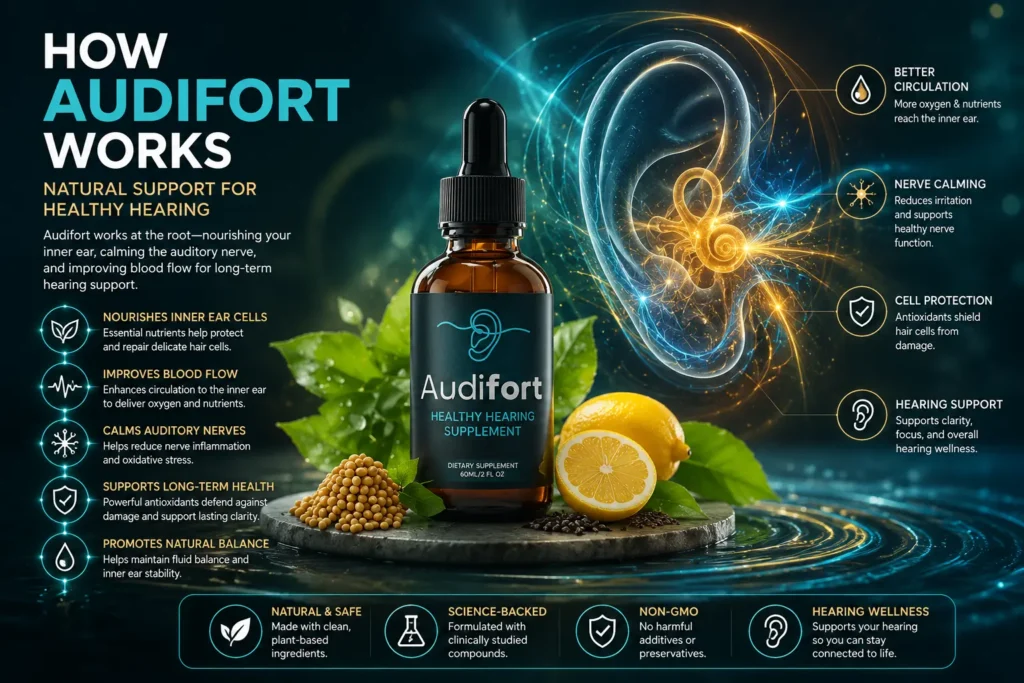
"Protects the auditory system" (grape seed, antioxidants)
Grape seed extract does have real antioxidant activity in general research, but we found no trial connecting it, at any dose, to a measured hearing or tinnitus outcome specifically.
"Enhances blood circulation to the ear" (green tea)
Green tea does have real, published cardiovascular and circulatory research generally: but no study we found connects that to ear-specific blood flow or a measurable hearing/tinnitus benefit.
"Calms auditory-cortex hyperexcitability" (GABA)
This claim requires oral GABA to cross the blood-brain barrier in meaningful amounts: and the evidence on whether it does is genuinely contradictory across studies, with the scientific consensus leaning skeptical. Even if GABA reaches the brain, no trial connects it to tinnitus specifically.
Ingredient disclosure
Audifort Ingredient Disclosure
We could not locate a fully transcribable ingredient panel with per-ingredient amounts for Audifort's 20+ named ingredients in any source available to us.
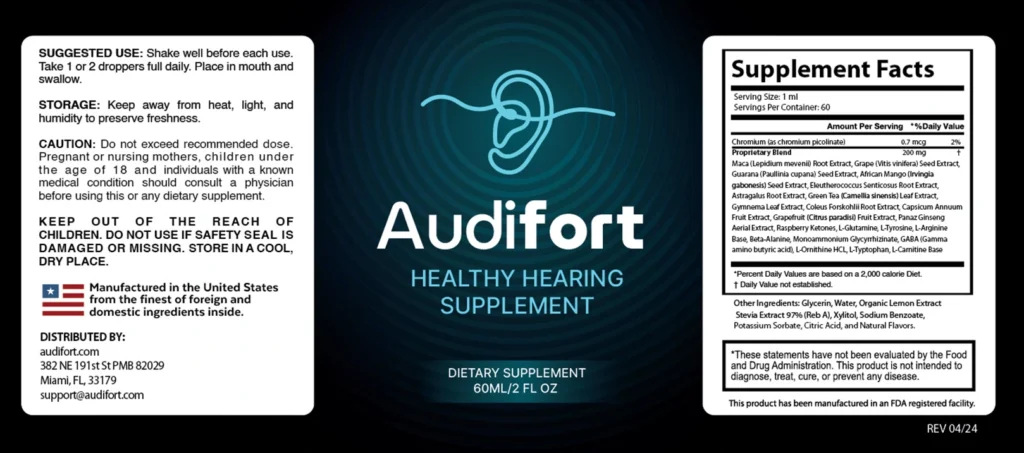
Other ingredients: Liquid carrier/base ingredients per the brand's own general description, specific inactive ingredients not independently confirmed by us.
Ingredients
Ingredient Evidence: What's Actually Been Studied for Hearing/Tinnitus
This is the most important section of this review. None of Audifort's named ingredients have direct hearing- or tinnitus-outcome trials behind them: a materially different, weaker evidence position than even the already-rejected supplements (ginkgo, zinc, melatonin) covered in the actual clinical guideline.
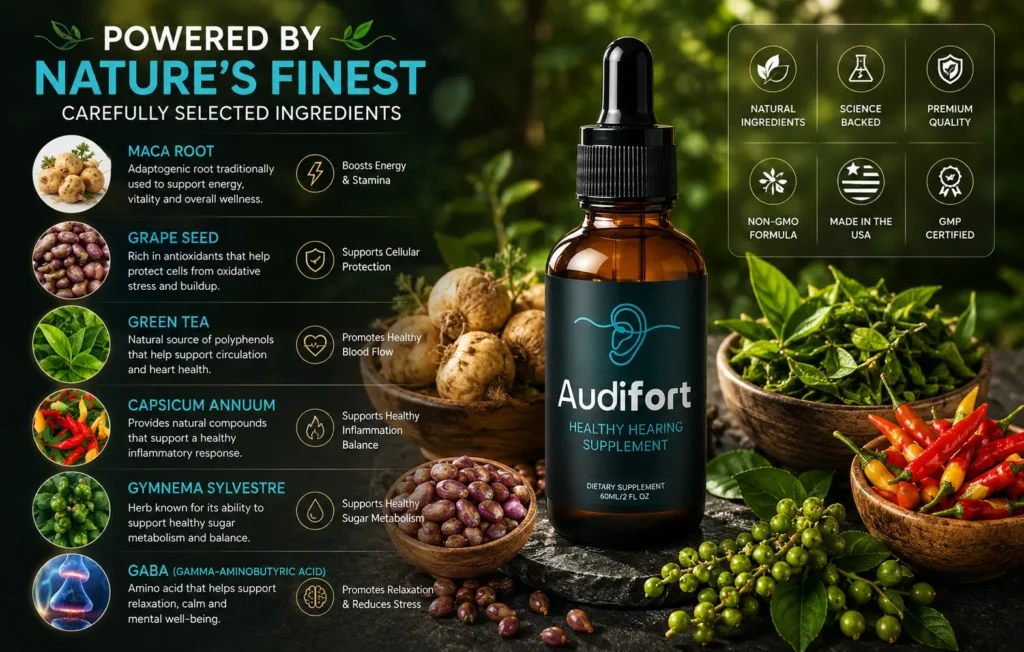
What real research says about supplements and tinnitus/hearing, and where Audifort's specific ingredients stand.
★☆☆ = studied and found ineffective/weak (for tinnitus specifically) · U = unverifiable, no direct trial for this claim exists. Evidence GRADE (per our SOP): A = finished formula studied · B = matching form & comparable dose studied for this exact claim · C = ingredient research exists but form/dose/applicability uncertain · D = mechanistic/animal only · U = unverifiable. Every ingredient here for the hearing/tinnitus claim specifically grades U, genuinely the weakest evidence position of any product in our line-up.
Results
What Audifort Can and Cannot Be Expected to Do
Given the evidence picture above, this section is necessarily short and cautious.
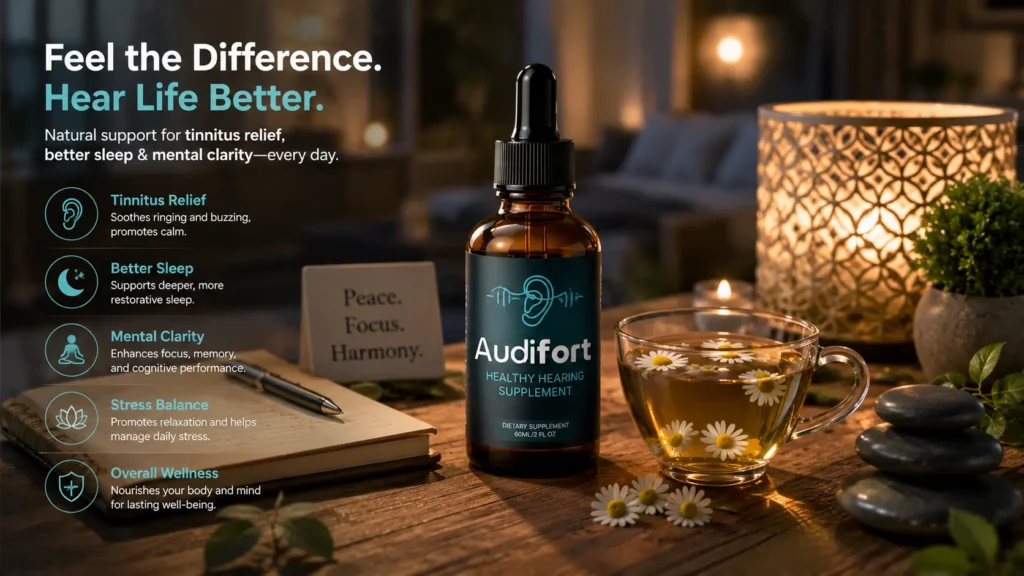
General wellness research on an ingredient does not establish that it treats tinnitus or supports hearing: that specific claim has not been tested for any of Audifort's named ingredients.
Pros & cons
Audifort Pros and Cons
A balanced assessment based on the label, real clinical guidance and ingredient evidence: not marketing claims.
- Liquid drops format may suit people who dislike capsules
- Most named ingredients are individually mild at typical doses
- Non-habit-forming, per the brand
- Manufactured, per the brand, in an FDA-registered, GMP-certified facility (not independently verified by us)
- Major clinical guidelines (AAO-HNS) explicitly recommend against supplements for tinnitus
- No ingredient in Audifort has direct hearing/tinnitus trial support: a weaker evidence position than even the already-rejected comparators (ginkgo, zinc)
- GABA's core "calms the auditory cortex" mechanism claim is scientifically disputed at the blood-brain-barrier level
- Per-ingredient doses are not disclosed in any source we could find
- 90-day guarantee is counted from purchase date, not delivery: a shorter effective window than it first appears
- Sold across many similar-looking domains: verify you're on the official checkout
Comparison
Audifort vs Seeing an Audiologist
This is a deliberately different kind of comparison than our usual product-vs-product table, because the real alternative to a tinnitus supplement is a clinical evaluation, not a competing product.
Pricing
Audifort Pricing and Refund Terms
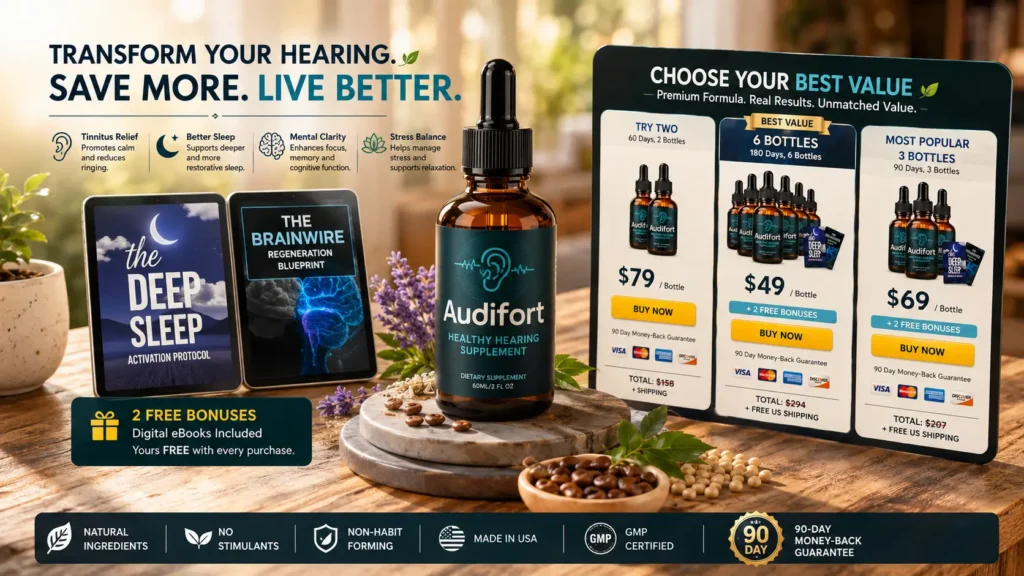
There is no single-bottle option: the smallest package is 2 bottles ($158 total, $79/bottle, +shipping, no bonuses). The 3- and 6-bottle packages both ship free within the US and include 2 free digital bonus guides, the 2-bottle package does not. Prices change, confirm the current price and total before checkout. Given the evidence picture above, consider whether a multi-bottle commitment makes sense before assuming it will address a hearing or tinnitus concern.
The brand advertises a 90-day money-back guarantee, counted from your purchase date (not delivery date). Per the vendor's own return policy, you must request a return authorization (RMA) within 90 days by emailing support@audifort.com, then ship the product back within 14 days of RMA approval to their Largo, FL address, the vendor does not cover return shipping costs, and the product must be in good physical condition with all original accessories. Per the vendor's own shipping policy, orders ship Monday-Friday with 1-2 business days processing before dispatch. We have not personally submitted or completed a refund request for this product. "Money-back" isn't the same as cost-free, read the full policy yourself before buying, and keep your order confirmation.
Check price on the official site →Legitimacy
Is Audifort Legit? An Honest, Not Recommended Verdict
Audifort is a real, sold product, we found no evidence it fails to ship or that its ingredient list is fabricated. But "real product" and "effective for its marketed purpose" are different questions, and on the second one, the evidence is genuinely weak: the American Academy of Otolaryngology-Head and Neck Surgery's own clinical practice guideline states clinicians should NOT recommend dietary supplements for tinnitus, because none has demonstrated reliable efficacy in peer-reviewed trials, a standard even the best-studied options (ginkgo, zinc, melatonin) fail to meet. Audifort's specific formula sits a step further back than even those: none of its named ingredients have been directly trialed for hearing or tinnitus outcomes at all.
How the verdict tiers work: we score every product 0–5 across five weighted checks (Ingredient Evidence 25%, Formula Transparency 20%, Safety & Tolerability 20%, Value & Guarantee 20%, Brand Trust & Manufacturing 15%), then apply a fixed scale, 4.3–5.0 = Recommended, 3.5–4.2 = Recommended with Reservations, 2.5–3.4 = Conditional, below 2.5 = Not Recommended. Audifort's near-zero Evidence score for its core marketed claim pulls the weighted average to 2.2, below the Conditional threshold. Full methodology: Our Review Process.
What we did NOT verify: we did not purchase and lab-test the product, obtain a certificate of analysis, or confirm the brand's manufacturing claims. This verdict is about the marketed hearing/tinnitus claim specifically, not an accusation of fraud, the ingredients themselves are common, generally-recognized-as-safe plant compounds, they simply haven't been shown to do what this product's marketing implies.
If you have persistent or bothersome tinnitus, please see a doctor or audiologist, real, evidence-based options exist (sound therapy, cognitive behavioral therapy, hearing aids, and treating underlying causes), and a clinical evaluation can catch a treatable cause a supplement never will.
New here? Read our full breakdown of what clinical guidelines actually say about supplements and tinnitus. See also our ZenCortex review (our second Not Recommended verdict in this category) and our direct Audifort vs ZenCortex comparison.
Purchase
Where to Buy Audifort
Audifort is sold through its official website. Our research also found it marketed across a number of similar-sounding domains, a common pattern for affiliate-funnel supplements, not necessarily a sign of fraud, but a reason to double-check you're on the vendor's actual checkout before entering payment details. The 90-day return window counts from your purchase date, not delivery, confirm the exact current terms before buying, and keep your receipt.
Dosage
How to Use Audifort (As Described by the Brand)
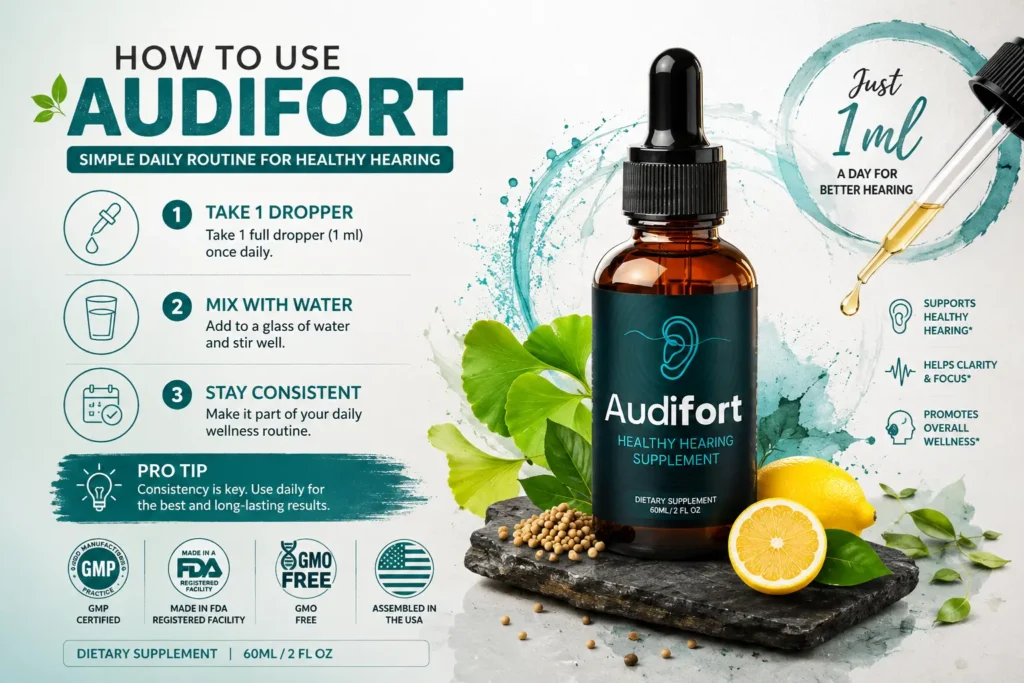
Label instruction: A measured dose of liquid drops, taken under the tongue or in water, per the brand's current directions. Always follow the directions on your current label.
Editorial tip (not label): If you have persistent or bothersome tinnitus, the highest-value next step is an audiologist or ENT evaluation: not a longer trial of any supplement, per the actual clinical guideline.
Consistency: There is no established "studied timeline" to reference here, since no trial of this formula or a comparable one for tinnitus was identified.
Lifestyle: Noise exposure, certain medications and underlying conditions are common, addressable contributors to tinnitus: worth discussing with a clinician regardless of any supplement decision.
Safety
Audifort Safety and Who Should Be Cautious
Most named ingredients have a generally mild safety profile individually at typical use: the primary concern with Audifort is evidentiary (does it work for the claimed purpose), not acute safety.
Common reactions (mild, usually temporary)
Mild digestive upset is possible with any new liquid supplement. Because doses are undisclosed, individual tolerance and any cumulative effect across 20+ ingredients can't be fully predicted.
Who should avoid it
See a doctor or audiologist first for any new, persistent, or worsening tinnitus or hearing change, self-treating with a supplement can delay identifying a treatable underlying cause (medication side effect, earwax blockage, noise damage, or a more serious condition). Sudden, one-sided, or pain-associated hearing loss needs prompt medical evaluation, not a supplement, it can occasionally signal a condition requiring urgent treatment (AAO-HNSF sudden hearing loss guideline). Also check first if pregnant or nursing, on blood-pressure medication (capsicum and green tea can have mild cardiovascular effects), or have a caffeine sensitivity (green tea contains some caffeine). Not for anyone under 18.
FAQs
Frequently Asked Questions About Audifort
Does Audifort actually help with tinnitus or hearing loss?
We found no evidence that it does. The American Academy of Otolaryngology's clinical practice guideline explicitly recommends against dietary supplements for tinnitus, and none of Audifort's specific ingredients have direct hearing/tinnitus trial support.
Why do you review a product with such weak evidence?
Because it's a real, legally sold product some readers are already considering, and we think an honest, clearly-stated evidence picture is more useful than silence. Our job is accurate information, not just positive reviews.
Is Audifort dangerous?
Most named ingredients have a generally mild safety profile individually at typical doses: our concern is that it doesn't do what it's marketed to do, not that it's acutely dangerous. Still check with a doctor before starting, especially if you're on blood-pressure medication.
What should I do instead if I have tinnitus?
See a doctor or audiologist. Evidence-based options include sound therapy, cognitive behavioral therapy, hearing aids, and identifying and treating underlying causes (medication side effects, earwax, noise exposure).
How much does Audifort cost?
$79 for two bottles down to about $49/bottle on the 6-bottle package. Prices change: confirm on the official site.
Is the guarantee real?
Yes: a 90-day money-back guarantee, processed through the brand's own return policy, counted from your purchase date (not delivery). You must request an RMA within 90 days and ship the product back within 14 days of approval, at your own cost.
Is Audifort a scam?
We found no evidence it fails to deliver a real product. Our concern is specifically that its marketed hearing/tinnitus claim isn't supported by evidence: that's a Not Recommended verdict for that claim, not a fraud accusation.
Final verdict
Final Verdict: Should You Try Audifort?
We can't identify a group for whom we'd recommend Audifort specifically for hearing or tinnitus support, given the evidence picture above. If you're drawn to its named ingredients for unrelated general-wellness reasons, evaluate them on their own (non-hearing) research, not this product's marketing claims.
Anyone with persistent or bothersome tinnitus or hearing changes: see a doctor or audiologist instead. Anyone expecting a hearing-restoration effect. Anyone who wants a product whose marketed claim is actually supported by clinical evidence.
Bottom line: Audifort is a real, sold liquid supplement, but its central marketed claim, hearing and tinnitus support, runs directly against the American Academy of Otolaryngology's own clinical practice guideline, which explicitly advises against dietary supplements for tinnitus because none has demonstrated reliable efficacy. None of Audifort's specific ingredients have been studied for this claim at all. Under our own methodology, that combination earns a Not Recommended verdict, our most skeptical verdict in this review series, reflecting a genuinely weak evidence picture, not a fraud accusation. If you have real hearing or tinnitus concerns, please see a doctor or audiologist.
References
References
- American Academy of Otolaryngology-Head and Neck Surgery Foundation. "Clinical Practice Guideline: Tinnitus." Otolaryngology-Head and Neck Surgery, 2014. entnet.org
- Sereda M, et al. "Ginkgo biloba for tinnitus." Cochrane Database of Systematic Reviews, 2022. DOI:10.1002/14651858.CD013514.pub2
- Zinc for tinnitus: randomized, double-blind, placebo-controlled crossover trial in elderly patients. PubMed, PMID 1872515
- "The Effect of Oral GABA on the Nervous System: Potential for Therapeutic Intervention." MDPI Audiology Research. MDPI Audiology Research 4(2):15
- Audifort: ingredient list as independently cross-checked across multiple third-party retail and review sources (no transcribable panel with doses found).
Update log
Corrections & updates
- 27 Jul 2026First published: full evidence-led build, led by checking Audifort's core marketed claim (hearing/tinnitus support) against the actual American Academy of Otolaryngology clinical practice guideline before researching any individual ingredient. Found the guideline explicitly recommends against dietary supplements for tinnitus, and that none of Audifort's specific ingredients have been directly studied for this use, a materially weaker position than even the guideline's own already-rejected comparators (ginkgo, zinc). Scored 2.2/5, our first Not Recommended verdict in this review series, reflecting genuinely weak evidence for the core claim rather than a safety or fraud concern.
- 10 Aug 2026Corrected against the live official sales page (audisoothe.com, the destination the registered affiliate link now resolves to): the 3-bottle tier was priced wrong ($59/bottle, $177 total), the real price is $69/bottle, $207 total, with free US shipping and 2 free bonus e-books, a detail this review was also missing for the 3- and 6-bottle tiers. The 2-bottle tier ($79/bottle, $158, +shipping) was already correct. Everything else (liquid-drop format, the 6 named headline ingredients plus 14+ additional per the brand's "over 20" claim, the 90-day guarantee terms) was already accurate and unchanged. Also confirmed via the live page's own customer testimonial ("I put a couple of drops in my morning coffee") that Audifort is taken orally, not applied to the ear.
Enjoying our content? Add us as a preferred source on Google.
Add us as a preferred source on GoogleDisclosures
Medical disclaimer
The statements on this page have not been evaluated by the Food and Drug Administration. This product is not intended to diagnose, treat, cure, or prevent any disease. Content is for educational and informational purposes only. Always consult a qualified healthcare professional before starting any new supplement.
Who wrote this
We are not doctors. We are independent researchers who spend dozens of hours analyzing peer-reviewed clinical trials so you don't have to. Every claim on this page is scored against our 5-Point Quality Filter and linked to its source.
Affiliate disclosure
DigiproSpark may earn a commission from purchases made through the affiliate links on this page at no additional cost to you. We only recommend products that pass our 5-Point Quality Filter. Our editorial opinions are not influenced by compensation.

About the author
Satwasheel Gharde
Founder & Head of Research, DigiproSpark
Founder of Smiley Social and Head of Research at DigiproSpark. Personally researches and edits every supplement review here using the 5-Point Quality Filter: transcribing the printed Supplement Facts label, sourcing peer-reviewed human evidence (PubMed / PMC / NIH), and checking clinical dosing before any verdict. Our reviews are evidence-and-label analyses, not medical advice; material safety points (drug interactions, contraindications) are written conservatively and flagged for a qualified clinician or pharmacist to confirm. Conflict-of-interest: pages may contain affiliate links that can earn a commission, which never changes a rating. Corrections & editorial contact: smileysocial@digiprospark.com.
Author of 17 published product reviews on DigiproSpark, each researched under the 5-Point Quality Filter. See the methodology →
Last updated: October 21, 2026