Comparison
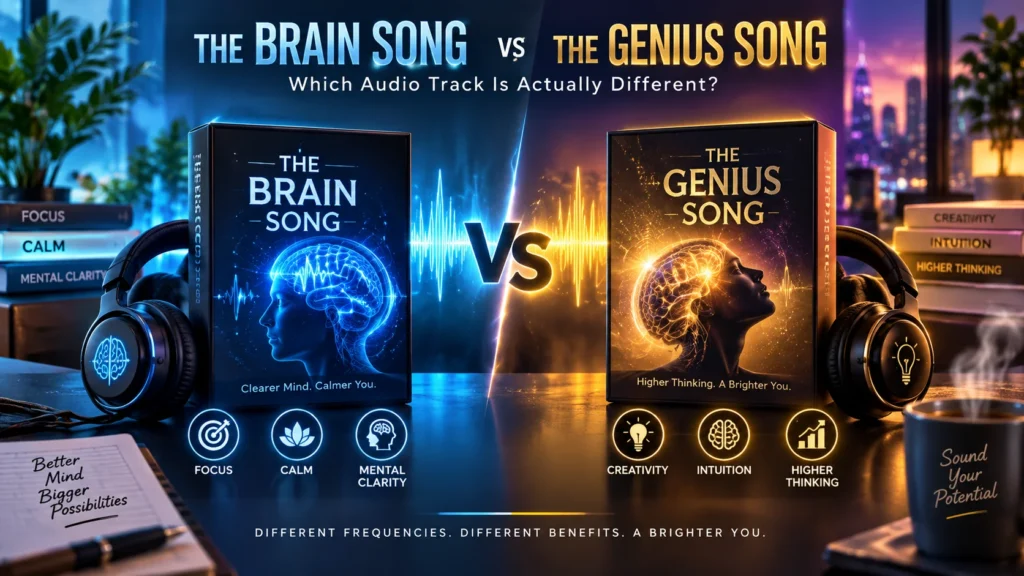
The Brain Song vs The Genius Song: Which Audio Track Is Actually Different?
The Brain Song and The Genius Song are both brainwave-entrainment audio tracks reviewed on this site, now scored on a dedicated Digital Audio Score built specifically for this product type rather than the supplement Trust Score used elsewhere on this site. Under that rubric they land 3.0/5 and 2.8/5 Conditional respectively, for genuinely different reasons, targeting different brainwave frequencies with different research behind each one.
Disclosure: DigiproSpark may earn a commission if you buy through links on this page, at no extra cost to you. It does not affect our evaluation. Educational content only; not medical advice. See our affiliate disclosure and medical disclaimer.
Watch
Video Walkthrough
Comparison
Side-by-Side
Why Frequency Target Actually Matters Here
Gamma (around 40Hz) and theta (roughly 4-8Hz) are different, well-studied bands of brain electrical activity associated with different cognitive states, gamma with attention and information binding, theta with relaxed, meditative, or memory-consolidation states. A product's claimed benefit only makes sense if it's actually delivering the frequency it says it is. An earlier version of this comparison flagged a real labeling inconsistency for The Genius Song, some third-party marketing described it as gamma-wave audio despite being sold as a theta track. Checking the actual, current official sales page directly resolves this: it states plainly the product targets Theta brain activity, with no mention of gamma anywhere.
What Neither Product Has: A Healthy-Adult Focus Trial
Both products share the same fundamental evidence gap: neither has been tested in a clinical trial of healthy adults using it specifically for everyday focus, which is how both are marketed. The Brain Song's gamma research is real and published, but it comes from Alzheimer's-pathology mouse studies and early-stage human Alzheimer's trials: a genuinely different population and health context than a healthy adult trying to concentrate at work. The Genius Song's theta-entrainment literature is smaller and more mixed. Treat either as a low-cost personal experiment, not a clinically proven cognitive enhancer, and track your own before/after experience across multiple listens rather than judging from one session. This shared evidence gap is exactly why both are scored on the Mechanism Evidence pillar of the Digital Audio Score, the same pillar that would be called "Ingredient Evidence" on a supplement review, renamed here because there's no ingredient to evaluate, only a claimed mechanism.
Which One Should You Try First?
If you want the track with more (even if population-mismatched) published research behind its specific frequency claim, that's The Brain Song. If you're specifically interested in theta-state relaxation or pre-sleep use rather than acute focus, The Genius Song's theta target is the more relevant one on paper: the official sales page now clearly confirms theta as the target frequency. Either way, check with a neurologist first if you have a seizure history, audio-only entrainment has a lower documented seizure-risk profile than flashing-light entrainment, but higher frequencies and rapid frequency shifts carry a theoretical caution. See our full how-to guide for gamma-frequency audio and brainwave-entrainment safety breakdown before starting either.
Enjoying our content? Add us as a preferred source on Google.
Add us as a preferred source on GoogleDisclosures
Medical disclaimer
This content is for educational purposes only and is not medical advice. It has not been evaluated by the FDA and is not intended to diagnose, treat, cure or prevent any disease. Consult a qualified healthcare professional before starting any supplement.
Who wrote this
We are not doctors. We are independent researchers who spend dozens of hours analyzing peer-reviewed clinical trials so you don't have to. Every claim on this page is scored against our 5-Point Quality Filter and linked to its source.
Affiliate disclosure
DigiproSpark may earn a commission from purchases made through affiliate links on this page at no extra cost to you. It does not change our editorial opinions.

About the author
Satwasheel Gharde
Founder & Head of Research, DigiproSpark
Founder of Smiley Social and Head of Research at DigiproSpark. Personally researches and edits every supplement review here using the 5-Point Quality Filter: transcribing the printed Supplement Facts label, sourcing peer-reviewed human evidence (PubMed / PMC / NIH), and checking clinical dosing before any verdict. Our reviews are evidence-and-label analyses, not medical advice; material safety points (drug interactions, contraindications) are written conservatively and flagged for a qualified clinician or pharmacist to confirm. Conflict-of-interest: pages may contain affiliate links that can earn a commission, which never changes a rating. Corrections & editorial contact: smileysocial@digiprospark.com.
Author of 17 published product reviews on DigiproSpark, each researched under the 5-Point Quality Filter. See the methodology →
Last updated: August 17, 2026