Comparison
CogniCare Pro vs The Brain Song: Capsule or Audio for Focus?
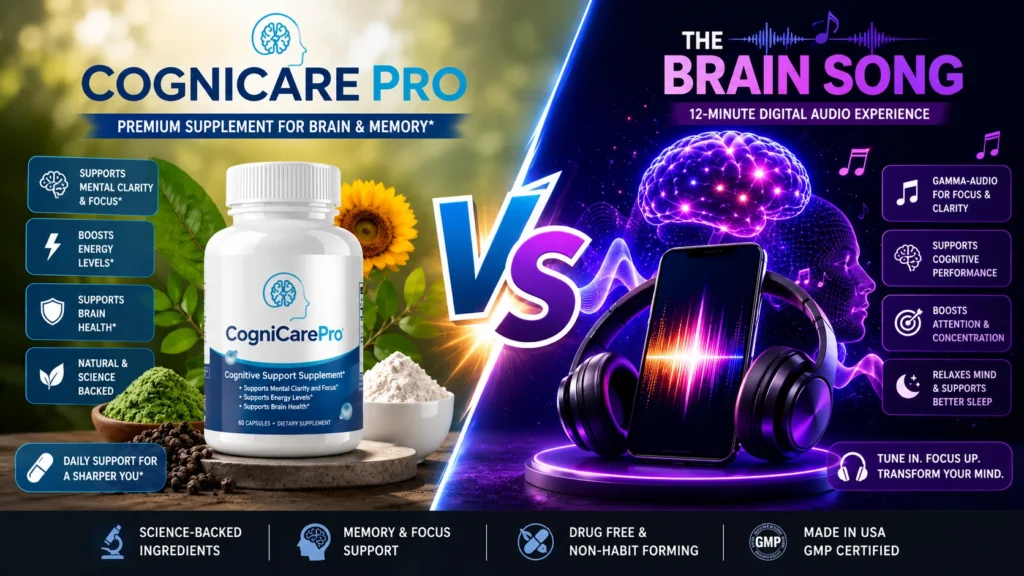
CogniCare Pro and The Brain Song both target focus and cognitive support, but they couldn't be more different in format: a capsule supplement versus a 40Hz gamma-frequency audio track. Because they're such different kinds of products, we score them on two different rubrics, CogniCare Pro on the supplement Trust Score, The Brain Song on the dedicated Digital Audio Score, so their numbers aren't directly interchangeable even though both land in the Conditional tier.
Disclosure: DigiproSpark may earn a commission if you buy through links on this page, at no extra cost to you. It does not affect our evaluation. Educational content only; not medical advice. See our affiliate disclosure and medical disclaimer.
Watch
Video Walkthrough
Comparison
Side-by-Side
The Huperzine A Interaction Risk, Explained
Huperzine A is a genuine acetylcholinesterase inhibitor: it works by slowing the breakdown of acetylcholine, the same basic mechanism class used by several prescription Alzheimer's medications (donepezil, rivastigmine, galantamine). That's not automatically dangerous, but it means combining CogniCare Pro with any of those prescription drugs, or with other cholinergic supplements, carries a real, mechanistically-grounded overstimulation risk (cholinergic overload) that most competing reviews don't flag with this specific detail. Anyone on a prescription cognitive medication should discuss CogniCare Pro with their doctor before starting it, not just "consult your doctor" as generic boilerplate.
Why The Brain Song's Research Doesn't Fully Transfer
The Brain Song's 40Hz gamma-frequency claim traces to real, published research from MIT's Picower Institute, but that research is overwhelmingly conducted in Alzheimer's-pathology mouse models and early-stage human Alzheimer's trials, not healthy adults trying to focus at work. That's a genuine population mismatch, not a reason to dismiss the product outright, but a reason to treat it as a low-cost personal experiment rather than a clinically proven focus enhancer. Since it's audio-only with no ingested compound, it carries none of CogniCare Pro's drug-interaction risk, a real, different kind of safety profile.
Could You Reasonably Use Both?
There's no known interaction between an ingested nootropic capsule and an audio-based entrainment track, they work through completely different pathways, so combining them isn't inherently risky the way stacking two cholinergic supplements would be. If you're drawn to CogniCare Pro specifically for its Bacopa monnieri content, that ingredient has real meta-analysis-level human evidence for memory and cognition, see our Huperzine A mechanism and safety guide for the full interaction breakdown before combining CogniCare Pro with any other cognitive-support product, prescription or otherwise.
Enjoying our content? Add us as a preferred source on Google.
Add us as a preferred source on GoogleDisclosures
Medical disclaimer
This content is for educational purposes only and is not medical advice. It has not been evaluated by the FDA and is not intended to diagnose, treat, cure or prevent any disease. Consult a qualified healthcare professional before starting any supplement.
Who wrote this
We are not doctors. We are independent researchers who spend dozens of hours analyzing peer-reviewed clinical trials so you don't have to. Every claim on this page is scored against our 5-Point Quality Filter and linked to its source.
Affiliate disclosure
DigiproSpark may earn a commission from purchases made through affiliate links on this page at no extra cost to you. It does not change our editorial opinions.

About the author
Satwasheel Gharde
Founder & Head of Research, DigiproSpark
Founder of Smiley Social and Head of Research at DigiproSpark. Personally researches and edits every supplement review here using the 5-Point Quality Filter: transcribing the printed Supplement Facts label, sourcing peer-reviewed human evidence (PubMed / PMC / NIH), and checking clinical dosing before any verdict. Our reviews are evidence-and-label analyses, not medical advice; material safety points (drug interactions, contraindications) are written conservatively and flagged for a qualified clinician or pharmacist to confirm. Conflict-of-interest: pages may contain affiliate links that can earn a commission, which never changes a rating. Corrections & editorial contact: smileysocial@digiprospark.com.
Author of 17 published product reviews on DigiproSpark, each researched under the 5-Point Quality Filter. See the methodology →
Last updated: August 17, 2026