Lifestyle Foundations
How Long It Actually Takes to Build a New Health Habit
The real research behind habit formation: a median of 66 days, not 21, with a range of 18 to 254 days, and why missing one day doesn't reset the process.
Disclosure: DigiproSpark may earn a commission if you buy through links on this page, at no extra cost to you. It does not affect our evaluation. Educational content only; not medical advice. See our affiliate disclosure and medical disclaimer.
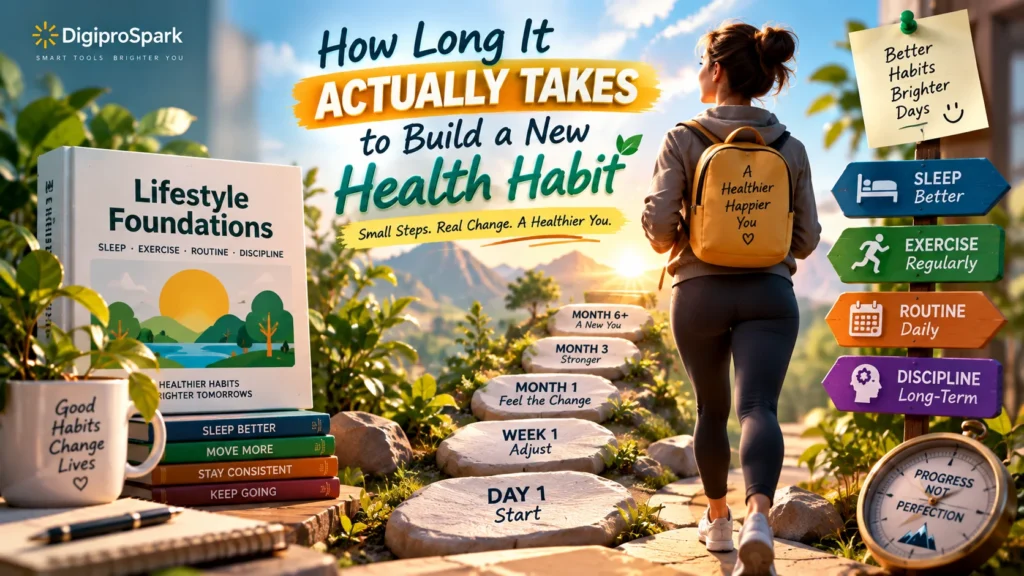
The “21 days to build a habit” claim gets repeated constantly. It isn’t from real research, it traces back to a 1960s plastic-surgery memoir, not a controlled study. The actual research paints a longer, more honest picture.
The real study
Lally et al. (2010, European Journal of Social Psychology) tracked 96 volunteers who each picked a daily eating, drinking, or activity behavior and reported on it for 12 weeks, measuring how automatic the behavior felt over time using a validated self-report scale. Of the 82 participants who provided enough data to analyze, the behavior reached a plateau of automaticity after a median of 66 days, but individual results ranged enormously: as few as 18 days for some people, as many as 254 days for others.
What actually predicted success

The study also found that missing a single day of the behavior did not meaningfully disrupt the habit-formation process, a genuinely reassuring, practical finding for anyone who’s ever “restarted” a streak after one slip.
How this applies if you’re starting a new supplement routine

A typical single bottle covers roughly 30 days. Per the real research above, that’s often before the habit has even become automatic, let alone before you’d have a fair read on whether the product itself is doing anything. If you’re evaluating a product from our Lifestyle Foundations perspective, budget closer to 8-9 weeks of consistent use before judging the routine as “not working for me,” and don’t let one missed dose derail the whole attempt.
Our Dosage & Timing Tool lets you pick a fixed daily trigger for a specific product, the same “if-then” structure that measurably increases follow-through in the real behavioral research.
FAQ
Is the 21-day habit myth completely wrong?
The actual controlled research found a 66-day median with huge individual variation, not a fixed 21-day rule. Some people did form a new automatic behavior faster than 21 days; most took considerably longer.
Does missing a day ruin my progress?
According to this study’s own data, no. A single missed occasion did not meaningfully disrupt the habit-formation trajectory.
Educational content only, not medical advice.
Enjoying our content? Add us as a preferred source on Google.
Add us as a preferred source on GoogleDisclosures
Medical disclaimer
The statements on this page have not been evaluated by the Food and Drug Administration. This product is not intended to diagnose, treat, cure, or prevent any disease. Content is for educational and informational purposes only. Always consult a qualified healthcare professional before starting any new supplement.
Who wrote this
We are not doctors. We are independent researchers who spend dozens of hours analyzing peer-reviewed clinical trials so you don't have to. Every claim on this page is scored against our 5-Point Quality Filter and linked to its source.
Affiliate disclosure
DigiproSpark may earn a commission from purchases made through the affiliate links on this page at no additional cost to you. We only recommend products that pass our 5-Point Quality Filter. Our editorial opinions are not influenced by compensation.

About the author
Satwasheel Gharde
Founder & Head of Research, DigiproSpark
Founder of Smiley Social and Head of Research at DigiproSpark. Personally researches and edits every supplement review here using the 5-Point Quality Filter: transcribing the printed Supplement Facts label, sourcing peer-reviewed human evidence (PubMed / PMC / NIH), and checking clinical dosing before any verdict. Our reviews are evidence-and-label analyses, not medical advice; material safety points (drug interactions, contraindications) are written conservatively and flagged for a qualified clinician or pharmacist to confirm. Conflict-of-interest: pages may contain affiliate links that can earn a commission, which never changes a rating. Corrections & editorial contact: smileysocial@digiprospark.com.
Last updated: October 19, 2026