Lifestyle Foundations
Willpower Isn’t a Tank You Empty: What Actually Replaced Ego Depletion Theory
The 'willpower is a limited resource' theory largely failed to replicate. Here's the real, still-standing research on what actually helps people follow through: if-then planning.
Disclosure: DigiproSpark may earn a commission if you buy through links on this page, at no extra cost to you. It does not affect our evaluation. Educational content only; not medical advice. See our affiliate disclosure and medical disclaimer.
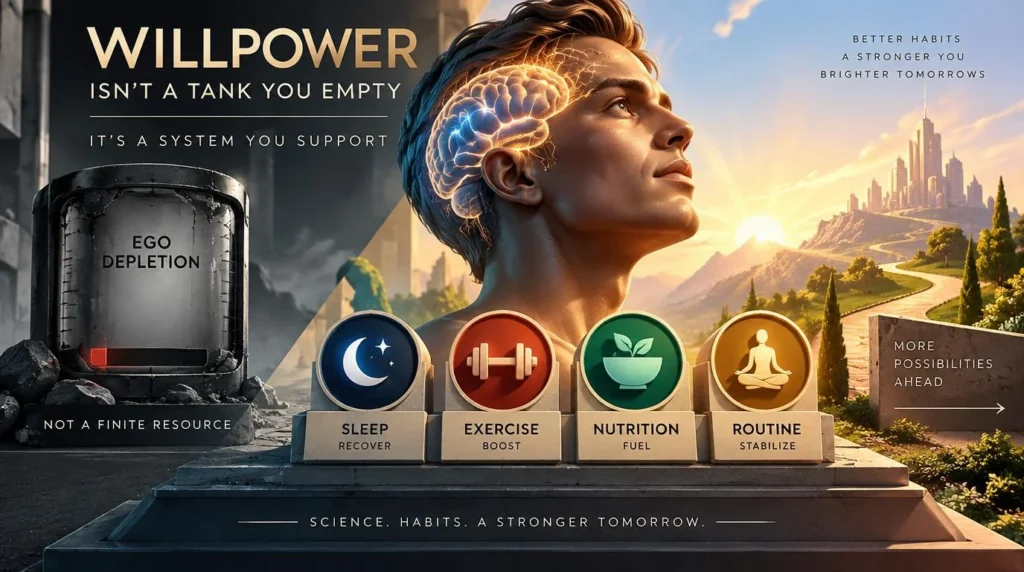
For years, the dominant model of willpower was simple: it’s a tank, and you drain it every time you resist a temptation or make a hard decision, leaving less for later. That model doesn’t hold up nearly as well as it used to.
What happened to ego-depletion theory
A large, coordinated multi-lab replication effort, 23 laboratories, more than 2,100 participants, failed to replicate the core ego-depletion effect. A subsequent meta-analysis that corrected for publication bias found the effect statistically indistinguishable from zero. The field doesn’t have a fully settled explanation for why earlier, smaller studies found the effect and this large replication didn’t; individual differences in people’s own beliefs about willpower appear to play a real role in the inconsistency. The honest summary: treating willpower as a depletable tank that empties over the course of a day is no longer something the evidence clearly supports.
What actually does hold up: implementation intentions
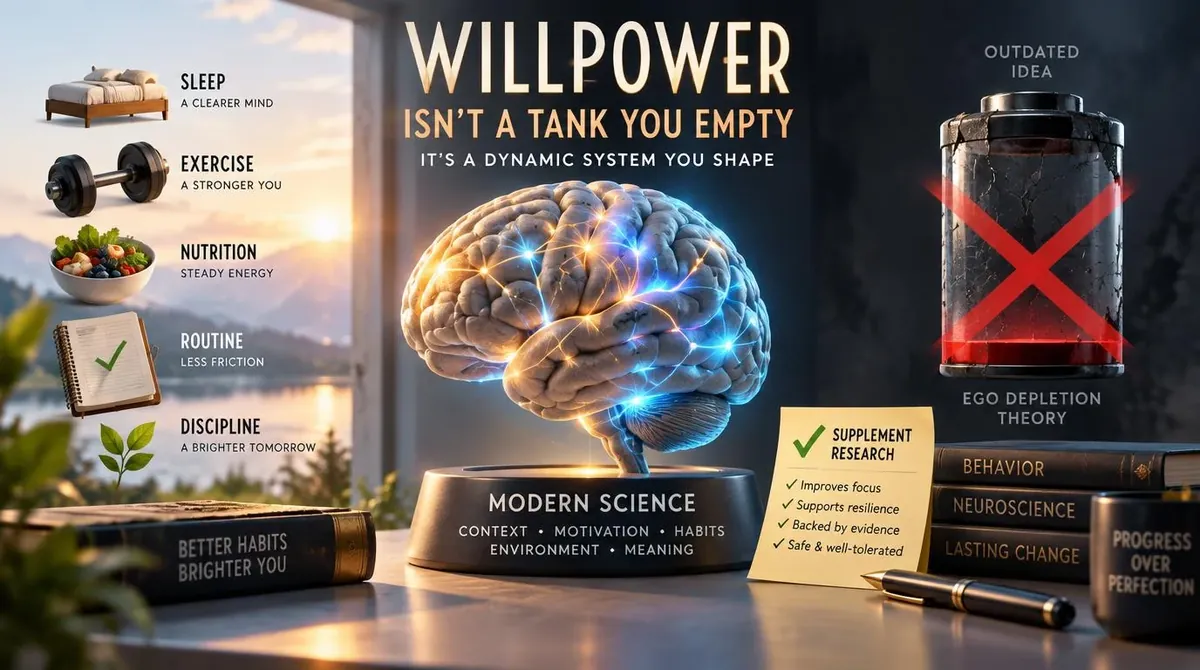
Decades of research by psychologist Peter Gollwitzer on “implementation intentions”, simple if-then plans made in advance (“If it’s 8am and I’ve eaten breakfast, then I take my supplement”), has consistently found they measurably increase follow-through on goals compared to a plain intention to “try to remember.” The mechanism isn’t more willpower: it’s removing the need to make a fresh decision, under real-world friction, every single time. You decide once, while calm and unhurried, and the decision executes automatically when the trigger occurs.
How to actually use this
- Don’t rely on “I’ll remember” or general motivation, that’s the model the research doesn’t support.
- Pick one fixed, specific trigger tied to something you already do daily (a meal, brushing your teeth, your first coffee).
- Write the if-then plan down once. The research shows the effect comes from forming the plan in advance, not from willpower at the moment of action.
Our Dosage & Timing Tool lets you set exactly this kind of fixed trigger for a specific product’s real label instruction, an evidence-based structure, not a gimmick.
FAQ
So willpower doesn’t exist?
That’s not what the research shows either. The specific claim that didn’t replicate is that willpower is a depletable resource that runs out over the course of a day from unrelated tasks. Self-control as a general concept is still real; the “tank” model of how it works is the part that’s now in serious doubt.
What should I do instead of relying on willpower?
Form specific if-then plans in advance, the one intervention with a strong, still-replicating evidence base for improving follow-through.
Educational content only, not medical advice.
Enjoying our content? Add us as a preferred source on Google.
Add us as a preferred source on GoogleDisclosures
Medical disclaimer
The statements on this page have not been evaluated by the Food and Drug Administration. This product is not intended to diagnose, treat, cure, or prevent any disease. Content is for educational and informational purposes only. Always consult a qualified healthcare professional before starting any new supplement.
Who wrote this
We are not doctors. We are independent researchers who spend dozens of hours analyzing peer-reviewed clinical trials so you don't have to. Every claim on this page is scored against our 5-Point Quality Filter and linked to its source.
Affiliate disclosure
DigiproSpark may earn a commission from purchases made through the affiliate links on this page at no additional cost to you. We only recommend products that pass our 5-Point Quality Filter. Our editorial opinions are not influenced by compensation.

About the author
Satwasheel Gharde
Founder & Head of Research, DigiproSpark
Founder of Smiley Social and Head of Research at DigiproSpark. Personally researches and edits every supplement review here using the 5-Point Quality Filter: transcribing the printed Supplement Facts label, sourcing peer-reviewed human evidence (PubMed / PMC / NIH), and checking clinical dosing before any verdict. Our reviews are evidence-and-label analyses, not medical advice; material safety points (drug interactions, contraindications) are written conservatively and flagged for a qualified clinician or pharmacist to confirm. Conflict-of-interest: pages may contain affiliate links that can earn a commission, which never changes a rating. Corrections & editorial contact: smileysocial@digiprospark.com.
Last updated: October 21, 2026