How-To Guides
Clinically-Relevant Dosing: Why “It’s In There” Isn’t Enough
What a "clinically-relevant dose" means, why proprietary blends make dosing unverifiable, and how to check a label's doses yourself.
Disclosure: DigiproSpark may earn a commission if you buy through links on this page, at no extra cost to you. It does not affect our evaluation. Educational content only; not medical advice. See our affiliate disclosure and medical disclaimer.
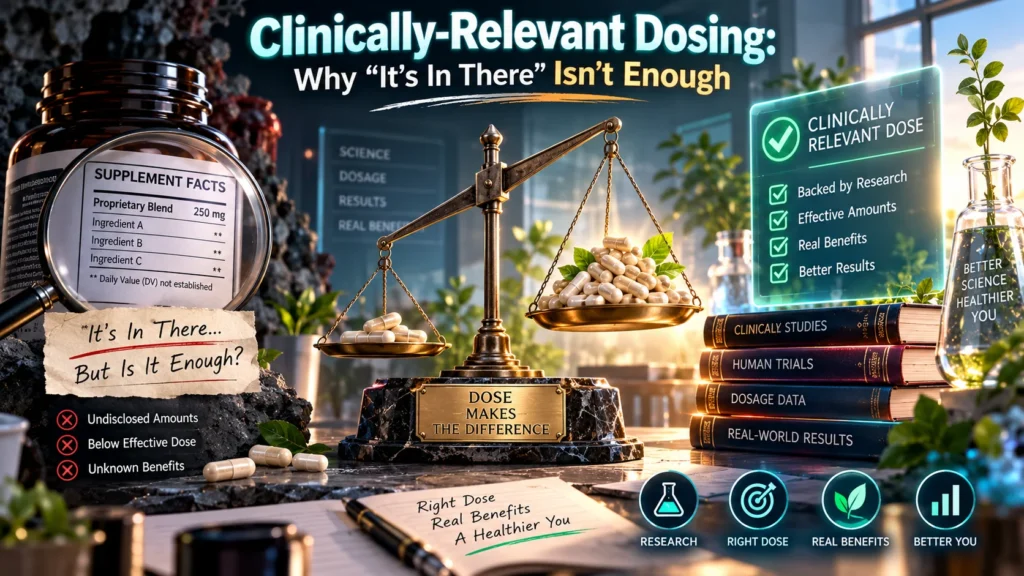
An ingredient being present on a label tells you almost nothing on its own. What matters is whether it’s present at an amount anywhere near what was used in the research behind it. This is the second of our 5-Point Quality Filter checks, and it’s where a lot of otherwise-impressive ingredient lists quietly fall apart.
What “clinically relevant” means
Most supplement ingredients have a published study, or several, establishing roughly what dose produced the measured effect. A “clinically-relevant dose” is one that’s in the same neighborhood as that research amount. A dose at a fraction of the studied amount hasn’t been shown to do anything, it’s on the label for the marketing value of the ingredient’s name, not for a dose that matches the evidence. This pattern has an informal industry nickname: fairy dusting.
Why hidden doses can’t pass this check
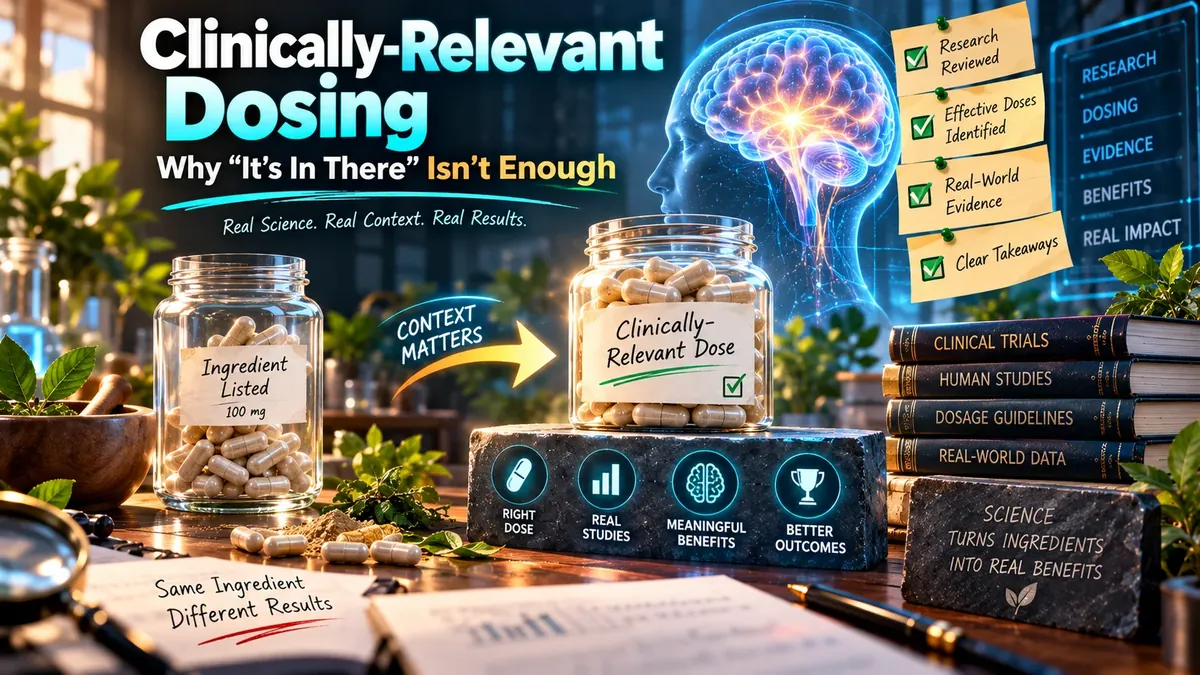
When a product’s actives sit inside a proprietary blend, only the combined total is disclosed: not each ingredient’s individual amount. That means dose adequacy literally cannot be verified for any single active in the blend. We don’t guess in the product’s favor: an unverifiable dose is scored as unverified, which is why proprietary-blend products are capped at our Conditional tier regardless of how well-researched the ingredients themselves are. See How We Grade Supplement Evidence (A–U) for how this interacts with our evidence grading.
How to check this yourself
- Look for a specific number (mg, mcg, or CFU) next to each ingredient: not just a name.
- Search the ingredient name plus “dose” or “clinical trial” to find the amount used in published research.
- If the label only gives a blend total, treat every ingredient inside it as an unverified dose, not a confirmed one.
See it applied

Our Nagano Lean Body Tonic review walks through exactly which of its 33 labeled ingredients sit inside proprietary blends versus which have individually stated amounts: a concrete example of this check in action, not just the theory.
Educational content only, not medical advice.
References
- NIH Office of Dietary Supplements: ods.od.nih.gov
- PubMed: pubmed.ncbi.nlm.nih.gov
- Google Search, Write high-quality product reviews, developers.google.com
Enjoying our content? Add us as a preferred source on Google.
Add us as a preferred source on GoogleDisclosures
Medical disclaimer
The statements on this page have not been evaluated by the Food and Drug Administration. This product is not intended to diagnose, treat, cure, or prevent any disease. Content is for educational and informational purposes only. Always consult a qualified healthcare professional before starting any new supplement.
Who wrote this
We are not doctors. We are independent researchers who spend dozens of hours analyzing peer-reviewed clinical trials so you don't have to. Every claim on this page is scored against our 5-Point Quality Filter and linked to its source.
Affiliate disclosure
DigiproSpark may earn a commission from purchases made through the affiliate links on this page at no additional cost to you. We only recommend products that pass our 5-Point Quality Filter. Our editorial opinions are not influenced by compensation.

About the author
Satwasheel Gharde
Founder & Head of Research, DigiproSpark
Founder of Smiley Social and Head of Research at DigiproSpark. Personally researches and edits every supplement review here using the 5-Point Quality Filter: transcribing the printed Supplement Facts label, sourcing peer-reviewed human evidence (PubMed / PMC / NIH), and checking clinical dosing before any verdict. Our reviews are evidence-and-label analyses, not medical advice; material safety points (drug interactions, contraindications) are written conservatively and flagged for a qualified clinician or pharmacist to confirm. Conflict-of-interest: pages may contain affiliate links that can earn a commission, which never changes a rating. Corrections & editorial contact: smileysocial@digiprospark.com.
Last updated: October 21, 2026