How-to guide
How Much Xylitol Do You Actually Need for Cavity Prevention? A Practical Dosing Guide
Xylitol is one of the most genuinely well-researched ingredients we've covered on this site for its specific claim, with real meta-analysis-level human evidence behind it: but the dose used in the actual research is considerably higher than what's in most single-serving dental products. Our ProvaDent review covers this exact gap for one specific product, this guide walks through the research-backed dosing itself so you know what to look for in any xylitol product, not just one.
Disclosure: DigiproSpark may earn a commission if you buy through links on this page, at no extra cost to you. It does not affect our evaluation. Educational content only; not medical advice. See our affiliate disclosure and medical disclaimer.
Watch
Video Walkthrough
Step by step
What the research actually used, step by step
Know the real effective range first
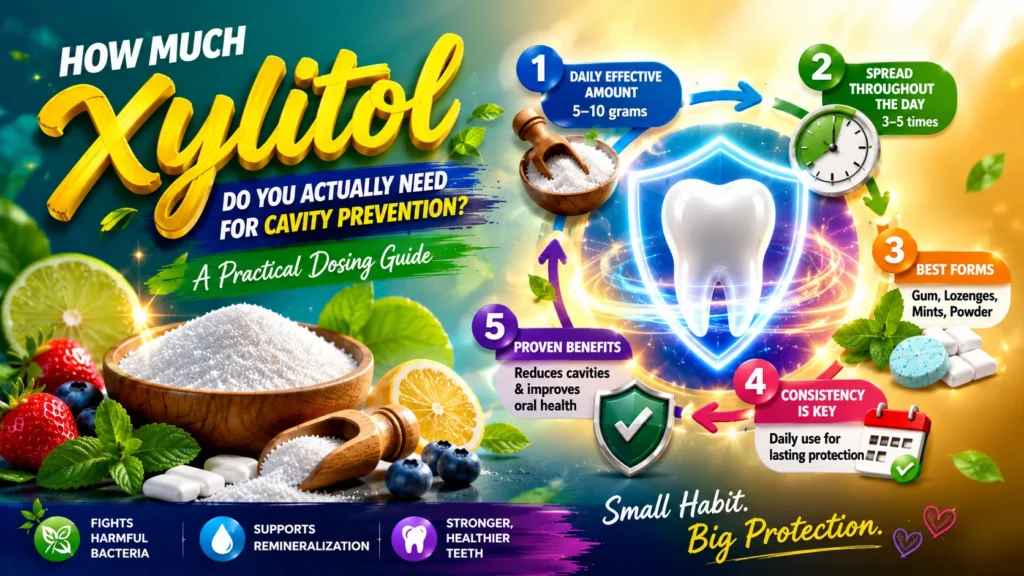
A meta-analysis on xylitol and caries prevention, published in the Journal of International Society of Preventive and Community Dentistry, found the most effective approach was 5-10 grams of xylitol per day, split across 3-5 exposures. Frequencies below roughly 3.44g/day showed no measurable caries-preventive benefit in the pooled data: a real, specific threshold, not a vague "more is better" impression.
Understand why frequency matters as much as total dose
The research measured effectiveness through repeated daily exposures, gum, lozenges, or mints used throughout the day, not one large dose taken all at once. The proposed mechanism (starving cavity-causing Streptococcus mutans bacteria of fermentable sugar, repeatedly, since bacteria can't metabolize xylitol the way they metabolize real sugar) depends on regular, repeated contact with teeth and saliva, not a single blood-level spike from one capsule.
Check what a single product actually delivers
A typical single dental capsule or chewable might contain anywhere from a few hundred milligrams to just over a gram of xylitol: read the label, don't assume. If a product's total daily xylitol is meaningfully below 3-5 grams, spread across only one exposure per day, it's reasonable to expect a smaller real-world effect than the meta-analysis demonstrated, even though the ingredient itself is genuinely well-supported at its studied dose.
Consider xylitol gum or mints as a practical add-on
Because the research protocol specifically used multiple daily exposures, xylitol chewing gum or mints used after meals, consistently, not occasionally, more closely matches the actual studied pattern than a single morning capsule, if cavity prevention specifically (not general oral wellness) is your goal.
Stay within the safe range regardless
Xylitol is considered safe for humans at doses up to roughly 6g/day, digestive-upset side effects become more likely at 4-5 times that amount (around 50g/day): a threshold most people would need to work at deliberately to reach through food and gum alone. The doses discussed throughout this guide are well within the safe range either way, so the dose gap here is a question of effectiveness, not safety.
Keep it away from dogs, always, no exceptions
Xylitol is toxic to dogs even in small amounts and is a genuine veterinary emergency if ingested (FDA, Xylitol and Dogs): this applies to gum, mints, and any capsule or chewable product containing it, at any dose discussed here. Store any xylitol-containing product securely and out of reach if you have a dog in the house, and know that this is one of the more common accidental-poisoning calls veterinary poison-control lines receive.
Why the dose gap exists in commercial products
Getting 5-10 grams of xylitol into a single small capsule isn't practical, that's a genuinely large amount of a sugar-alcohol compound by supplement standards, and most capsules or chewables are formulated around a few hundred milligrams to a couple of grams at most for any single ingredient, both for size/swallowability reasons and cost. This is a real, understandable formulation constraint, not necessarily bad faith on any single brand's part, but it does mean a product marketing a dental "sugar hack" while actually delivering well under a gram of xylitol per day is delivering a genuinely real, well-researched ingredient at a dose meaningfully below where its own best supporting evidence was demonstrated.
This is a pattern worth recognizing beyond just xylitol: a well-cited ingredient in a product's marketing doesn't automatically mean the product delivers that ingredient's effective dose. Checking the actual disclosed amount against the cited research's dose is a genuinely useful habit for evaluating any supplement claim, not just this one.
What this means for your expectations
This doesn't mean a lower-dose xylitol product does nothing: dose-response relationships in nutrition research are rarely strictly all-or-nothing, and some benefit at a lower dose remains biologically plausible even without direct trial data at that specific lower amount. But it does mean you shouldn't expect the same caries-reduction effect the meta-analysis found at 5-10g/day from a product delivering under a gram once daily. Treat a lower-dose product as one small, genuinely safe input alongside standard dental care, not a substitute for the frequency and total dose the actual research used to produce its measured effect.
Where this applies to ProvaDent and DentaBiome
ProvaDent discloses 900mg of xylitol per serving, individually and transparently dosed, a genuine structural plus over many competing products that hide their formula inside one combined blend total, but still meaningfully below the 5-10g/day range shown effective for cavity prevention specifically. See our full ProvaDent review for the complete ingredient breakdown, including its BioFresh enzyme complex and standardized cranberry extract, and our full Trust Score calculation, the highest-scoring product in our recent review batch, held back specifically by this checkable dose gap rather than any hidden ingredient.
DentaBiome also names xylitol among its ingredients, but doesn't disclose an amount at all, a related but distinct gap from ProvaDent's: not "a real dose below the effective range," but "no way to check the dose against the research in the first place." See our full DentaBiome review for the complete picture.
Enjoying our content? Add us as a preferred source on Google.
Add us as a preferred source on GoogleDisclosures
Medical disclaimer
This content is for educational purposes only and is not medical advice. It has not been evaluated by the FDA and is not intended to diagnose, treat, cure or prevent any disease. Consult a qualified healthcare professional before starting any supplement.
Who wrote this
We are not doctors. We are independent researchers who spend dozens of hours analyzing peer-reviewed clinical trials so you don't have to. Every claim on this page is scored against our 5-Point Quality Filter and linked to its source.
Affiliate disclosure
DigiproSpark may earn a commission from purchases made through affiliate links on this page at no extra cost to you. It does not change our editorial opinions.

About the author
Satwasheel Gharde
Founder & Head of Research, DigiproSpark
Founder of Smiley Social and Head of Research at DigiproSpark. Personally researches and edits every supplement review here using the 5-Point Quality Filter: transcribing the printed Supplement Facts label, sourcing peer-reviewed human evidence (PubMed / PMC / NIH), and checking clinical dosing before any verdict. Our reviews are evidence-and-label analyses, not medical advice; material safety points (drug interactions, contraindications) are written conservatively and flagged for a qualified clinician or pharmacist to confirm. Conflict-of-interest: pages may contain affiliate links that can earn a commission, which never changes a rating. Corrections & editorial contact: smileysocial@digiprospark.com.
Author of 17 published product reviews on DigiproSpark, each researched under the 5-Point Quality Filter. See the methodology →
Last updated: August 2, 2026