How-To Guides
Evidence Quality: Human Trials, Animal Studies, and Marketing Claims Aren’t the Same Thing
Why human trials, animal studies, and marketing claims aren't interchangeable evidence, and how we check every citation before trusting it.
Disclosure: DigiproSpark may earn a commission if you buy through links on this page, at no extra cost to you. It does not affect our evaluation. Educational content only; not medical advice. See our affiliate disclosure and medical disclaimer.
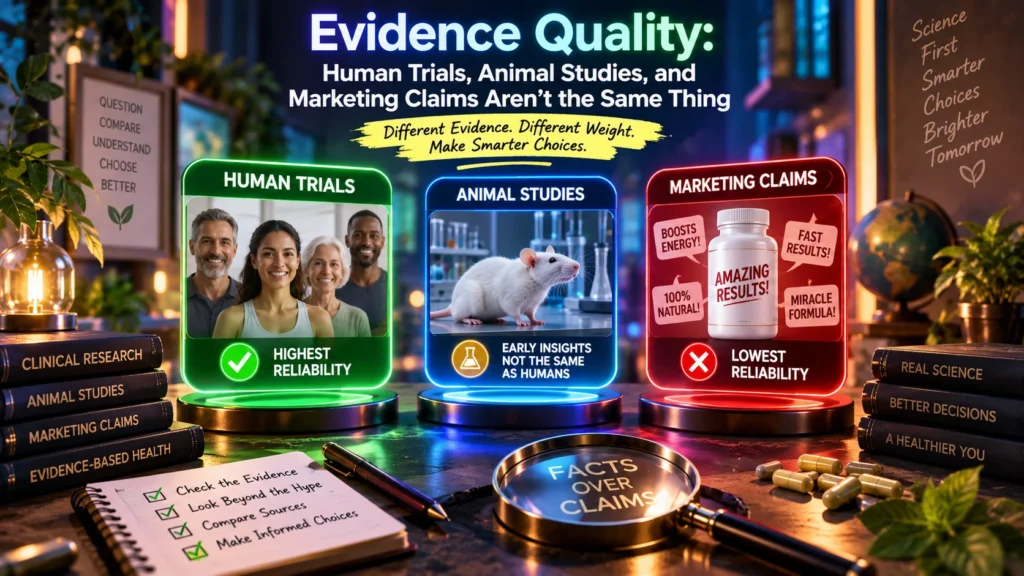
Not all “backed by science” is backed the same way. A citation can point to a large human trial, a small pilot study, a rodent experiment, or a brand’s own unpublished whitepaper: and marketing copy rarely tells you which. This is the third of our 5-Point Quality Filter checks: we prioritize human, peer-reviewed research over everything else, and we say plainly when the evidence is thin.
A rough hierarchy

- Strongest: independent, peer-reviewed human trials: ideally more than one, ideally at the dose the product actually uses.
- Moderate: human research that exists but is small, short, industry-funded, or uses a different dose or ingredient form than the product on the shelf.
- Weak: animal or cell-culture (in vitro) studies. These can show a plausible mechanism, a reason an effect might occur, but a result in a mouse or a petri dish is not a result in a person.
- Not evidence: a brand’s own marketing whitepaper, a single testimonial, or a claim with no traceable source at all.
Why we read every citation ourselves
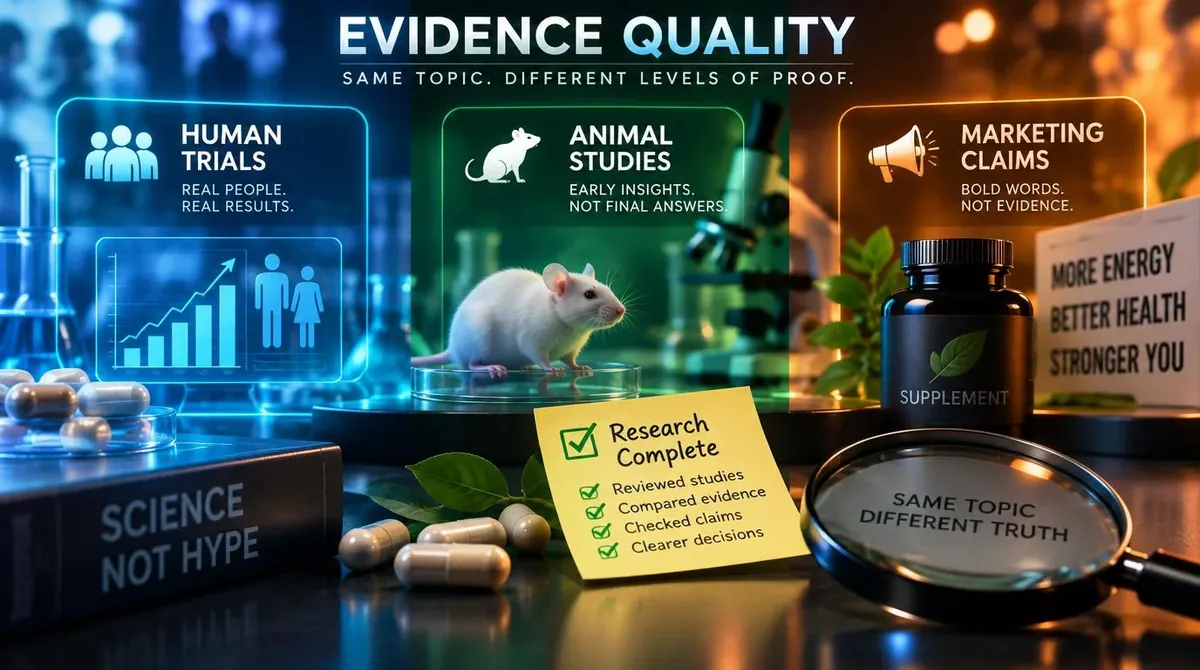
A footnote number next to a claim doesn’t confirm the claim: it only confirms someone attached a citation. We open every source cited in a review and check that it actually says what’s being claimed, rather than taking a brand’s characterization of its own citation at face value. This is also why our reviews link out to primary sources (PubMed, PMC, NIH) in full, dofollow, so you can independently verify the same thing.
How this feeds our letter grades
This evidence hierarchy is the foundation of our full A–U evidence grading system: that post walks through exactly how a citation’s strength translates into a letter grade, and how those grades interact with the dosing check to determine a product’s final verdict.
The honest reality
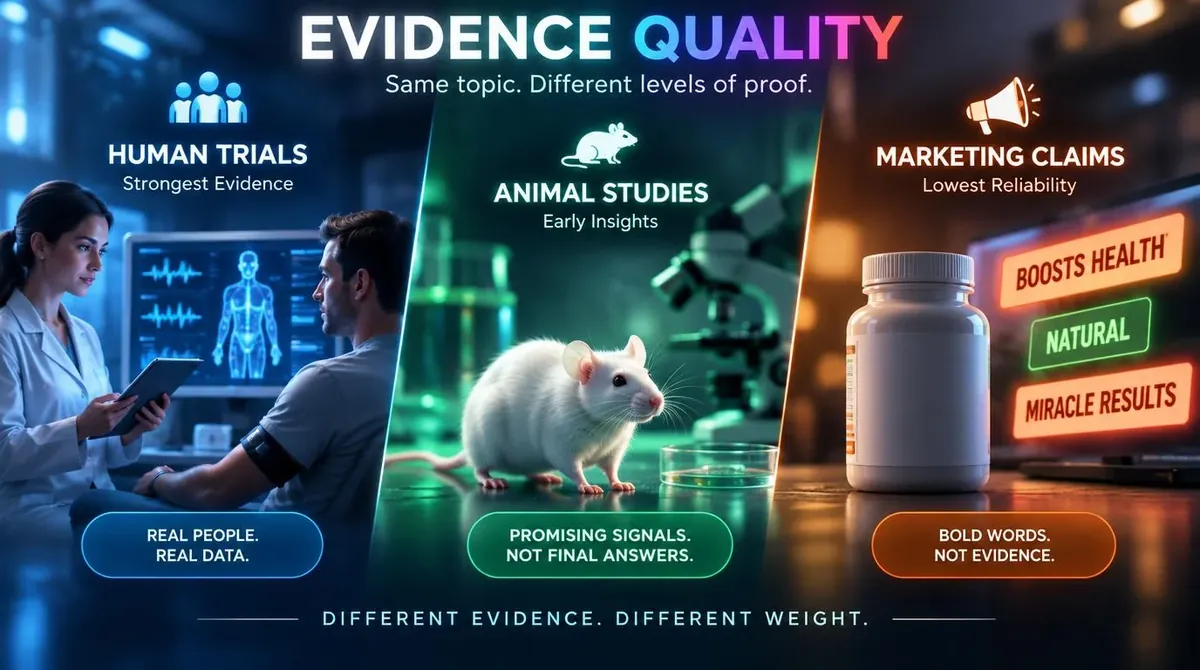
Most supplement ingredients have some human research, but very few finished products have been tested as a complete formula. That gap, general ingredient research vs. specific product proof, is the single most common reason a product we review earns a Conditional verdict rather than a full recommendation, as in our Nagano Lean Body Tonic review.
Educational content only, not medical advice.
References
- PubMed: pubmed.ncbi.nlm.nih.gov
- NIH Office of Dietary Supplements: ods.od.nih.gov
- Google Search, Write high-quality product reviews, developers.google.com
Enjoying our content? Add us as a preferred source on Google.
Add us as a preferred source on GoogleDisclosures
Medical disclaimer
The statements on this page have not been evaluated by the Food and Drug Administration. This product is not intended to diagnose, treat, cure, or prevent any disease. Content is for educational and informational purposes only. Always consult a qualified healthcare professional before starting any new supplement.
Who wrote this
We are not doctors. We are independent researchers who spend dozens of hours analyzing peer-reviewed clinical trials so you don't have to. Every claim on this page is scored against our 5-Point Quality Filter and linked to its source.
Affiliate disclosure
DigiproSpark may earn a commission from purchases made through the affiliate links on this page at no additional cost to you. We only recommend products that pass our 5-Point Quality Filter. Our editorial opinions are not influenced by compensation.

About the author
Satwasheel Gharde
Founder & Head of Research, DigiproSpark
Founder of Smiley Social and Head of Research at DigiproSpark. Personally researches and edits every supplement review here using the 5-Point Quality Filter: transcribing the printed Supplement Facts label, sourcing peer-reviewed human evidence (PubMed / PMC / NIH), and checking clinical dosing before any verdict. Our reviews are evidence-and-label analyses, not medical advice; material safety points (drug interactions, contraindications) are written conservatively and flagged for a qualified clinician or pharmacist to confirm. Conflict-of-interest: pages may contain affiliate links that can earn a commission, which never changes a rating. Corrections & editorial contact: smileysocial@digiprospark.com.
Last updated: October 21, 2026