
You may feel torn between celebrating and keeping the progress you worked so hard for. I know that tug—the late flights, heavy meals, and squeezed gym time make it easy to worry about loss. This guide meets you there with practical, science-backed ways to protect gains while you enjoy the season.
Over the next few paragraphs you’ll get a clear, future-focused plan: a 6-week, 3-days-per-week dumbbell approach, plus short micro-workouts and 12-minute formats that preserve conditioning when time is tight.
You’ll also see exactly where supplements fit—from protein-first meals to creatine, vitamin D, omega-3s, magnesium, and electrolytes—to support energy and recovery on the road. Expect links to travel templates, cozy cardio, rucking, bodyweight circuits, and recovery strategies so you can dive deeper without friction.
This section maps what comes next and shows how small, smart choices keep your progress steady. Stick with intensity over volume, use short sessions when needed, and rely on targeted supplements to help you finish the season stronger into the new year.
Key Takeaways
- Short, intense workouts and a 6-week, 3x/week plan protect muscle and progress.
- Three 10-minute bouts or 12-minute HIIT can match longer cardio sessions.
- Rucking boosts calorie burn with less joint impact than running.
- Protein-first meals plus creatine, vitamin D, omega-3s, and electrolytes aid recovery and energy.
- Travel-friendly templates and micro-workouts keep you consistent without a gym.
- Maintain one-third of usual volume at similar intensity to avoid measurable loss.
Start Smart: Your How-To Plan for the Holiday Season
Start by choosing a simple, six-week goal that fits the real life you have coming up. That one decision keeps workouts useful and stress low. Build a short plan that matches travel days, family events, and work deadlines so you can stay consistent without strict rules.
Set clear goals for the next six weeks, not the whole year
Pick bite-sized goals: two training days per week plus one flexible session. These targets protect muscle and let you enjoy meals without rigid restriction.
Align your schedule with reality: travel, family, and work
Map your week against travel and family plans. Save one morning window for shared activity and one buffer day around flights.
“Short, consistent sessions beat sporadic intensity when life gets busy.”
Quick plan options
| Plan | Duration | Purpose | When to use |
|---|---|---|---|
| Full | 30 min | Complete full-body training | Normal week, no travel |
| Backup | 12 min | High-intensity maintenance | Busy days or evenings |
| Snack | 3–10 min | Keep movement and blood flow | Flight days or tight schedules |
Action steps: save your six-week goals as a calendar note, slot realistic sessions, and check in weekly. Link this plan to the pillar planning hub and clusters on goal setting, travel workouts, and family activity ideas for printable templates and checklists.
Holiday fitness maintenance: the minimum effective dose that works
You don’t need daily gym trips—two to three quality sessions preserve most gains. Keep volume low but intensity high so each session sends a clear signal to your muscle and nervous system. Research shows about one-third of normal volume can maintain strength when effort is maintained.
Train fewer days, keep intensity: two to three sessions per week
Use two to three full-body sessions per week to hit all major muscle groups. A single 30-minute workout or three 10-minute bouts can protect strength and prevent measurable loss for several weeks.
Mix modalities for adherence: strength, cardio, and movement “snacks”
Schedule one strength day, one conditioning or ruck-style walk, and one micro-session day. Add exercise snacks—three 10-minute blocks or short bursts—to sustain cardio without long workouts.
Weekly template you can follow anywhere
- Mon — Full-body strength (AMRAP or EMOM)
- Wed — 12-minute HIIT (MaxT3 style)
- Fri — Ruck or brisk incline walk
“Short, intense sessions protect muscle better than sporadic long workouts.”
| Template | Duration | Purpose |
|---|---|---|
| Full-body | 30 min | Strength, compound lifts, preserve muscle |
| Micro HIIT | 12 min | Conditioning, high intensity, travel-friendly |
| Snack | 3–10 min | Circulation, low fatigue, maintain cardio |
Track weeks as wins when you complete two sessions plus daily movement. Check recovery signs—sleep and soreness—to adjust intensity. For templates and printable weekly schedules, interlink to pillar templates and clusters on full-body routines, high-intensity options, and exercise snacks.
Micro-workouts you can do throughout the day
Short bursts of focused movement scattered through your day keep progress intact when time is tight. Use three separate 10–12 minute sessions to match a 30-minute session for cardiovascular benefit and to boost focus.
The 10–12 minute sessions: when, how, and why they preserve progress
When time is limited, intensity matters more than duration. Research shows three 10-minute bouts can equal one 30-minute bout for aerobic gain. A 12-minute MaxT3-style protocol also hits strength and conditioning without equipment.
Exercise snacking ideas at home, office, airport, and hotel
- Stack one before your morning shower, one at lunch, and one before dinner to create a simple routine across the day.
- Office moves: wall sits during calls, desk push-ups, and calf raises while you brew coffee.
- Travel moves: suitcase deadlifts in the hotel, stair sprints at the airport, and hallway walking intervals.
A quick circuit for busy days (no equipment, travel-friendly)
Anywhere 10-minute circuit: 1 min each of push-ups, squats, high knees, forearm plank, burpees — repeat twice.
“Micro-workouts under 30 minutes sharpen focus and protect conditioning when your schedule is full.”
| Session Type | Duration | Primary Benefit |
|---|---|---|
| Three micro sessions | 3 × 10–12 min | Cardio parity with 30-min session, cognitive boost |
| 12-minute MaxT3 | 12 min | High-intensity, full-body stimulus without equipment |
| No-equipment circuit | 10 min | Quick strength and conditioning on the go |
Practical tips: set timers to cue sessions, rotate upper, lower, and full-body micro-workouts each week, and log quick notes so you see cumulative activity across the week. For printable routines, interlink to our micro-workouts cluster, office/airport movement snacks, and no-equipment travel circuits to slot these sessions beside your pillar template.
Strength without a gym: bodyweight and resistance band routines
A portable routine that hits key movement patterns preserves strength even on travel days.
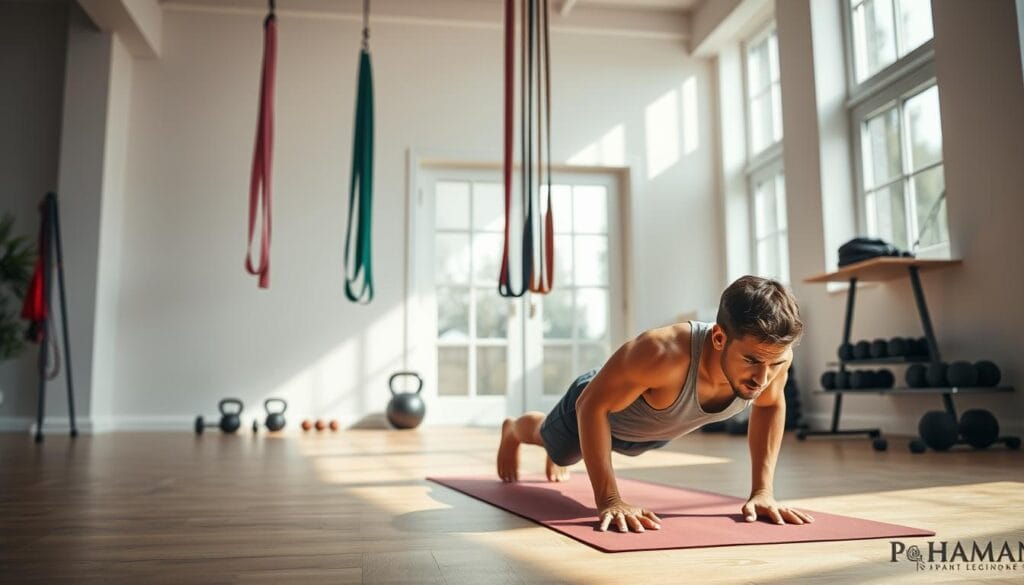
The five movement patterns that maintain muscle and strength
Train the squat, single-leg lunge, push, pull, and core rotation each session.
These patterns cover major muscles and keep your nervous system engaged. Do at least one exercise from each group every workout.
15–20 minute bodyweight and band circuits for travel days
Use short circuits to deliver a clear strength signal in limited time.
Bodyweight circuit (2–3 rounds): squats 12, lunges 10/leg, push-ups 10, inverted rows 10, standing twists 10/side.
Band circuit (2–3 rounds): band squats 12, chest press 12, seated rows 12, curls 12, lateral walks 10 steps each way.
“Keep sessions short and focused to protect muscle mass without hunting for a gym.”
Progressive planks and posture-saving pull-aparts for long flights
Do pull-aparts 3 × 12–15 with a 2-second squeeze to strengthen the upper back.
Progressive plank series (2–3 sets): forearm plank 30s, side planks 20s each, high plank taps 30s, plank-to-down-dog 10 reps.
- Adjust difficulty with tempo, range of motion, or unilateral variations to match your level.
- Pack a light-to-medium band to convert any space into a portable gym.
- Link these circuits into your travel days and the pillar weekly template for consistency.
| Routine | Duration | Main Focus | When to Use |
|---|---|---|---|
| Bodyweight Circuit | 15–20 min | Full-body strength, no equipment | Hotel rooms, parks |
| Band Circuit | 15–20 min | Constant tension, upper/lower balance | Travel, limited space |
| Plank & Posture Set | 10–12 min | Core stability and upper-back health | Long flights, desk days |
Action tip: track how your muscles feel in each movement pattern and rotate exercises to avoid overuse while preserving strength and muscle mass.
Cardio that fits your life: rucking and cozy cardio options
You can keep energy and aerobic fitness with short, low-friction cardio that fits family life.
Rucking offers a big calorie return for small extra effort. Research shows about 325 calories burned per 30 minutes of rucking versus ~125 for easy walking. You get more burn with far less joint loading than running—roughly 2.7x body weight impact for rucks versus about 8x for running.
Ruck walks to boost calorie burn with joint-friendly impact
Start light: beginners should carry 5–10 pounds (about 10% of body weight) for ~20 minutes. Increase weight or duration slowly—don’t do both at once.
- Advanced: 20–30 pounds for 45–60 minutes, add hills or stairs for intensity.
- Fold rucks into daily activity—school drop-offs, errands, or evening strolls—and bring family along for walk-and-talk sessions.
- Use inclines or stair repeats when time is short to raise performance without long workouts.
Cozy cardio for low-stress, high-consistency mornings
Cozy cardio is Zone 1–2 movement at a conversational pace. Think easy cycling, walking pads, or gentle flow.
Benefit: it preserves energy and recovery while reinforcing habit. Combine one ruck and one cozy session per week as a realistic aerobic base for the training week.
“Track heart-rate or use the talk test to match the right level for the day.”
| Mode | Duration | When to use |
|---|---|---|
| Ruck | 20–60 min | When you want higher burn, low impact |
| Cozy cardio | 15–40 min | High-stress mornings or recovery days |
| Incline/stairs | 10–30 min | Time-crunched intensity boosts |
Links: check our rucking how-to cluster, cozy cardio routines, and family-friendly cardio ideas for pacing charts, playlists, and practical guides.
Nutrition and supplements to protect gains during holidays
When travel and family time compress your schedule, food choices and a few supplements carry your gains.
Protein-first approach: lead each meal with a solid protein source to support muscle mass and recovery. Pair protein with veggies and a modest starch. This approach helps you enjoy celebrations while hitting targets without strict restriction.

Smart supplements that back your training
Build a simple stack: creatine monohydrate daily for strength and retention, vitamin D in low-light weeks, magnesium at night for sleep and muscle function, omega-3s with meals for recovery, and electrolytes around sessions or travel days.
Travel-ready strategies and timing
Use pairing over restriction: fill plates with protein and produce first, then add favorites. Pack snack kits (jerky, whey, nuts) and time caffeine 60–90 minutes before a workout or brisk walk to boost energy without hurting sleep.
“Short breaks of one to two weeks show minimal loss when you keep intensity and protein intake.”
| Focus | Action | When |
|---|---|---|
| Protein-first | Anchor every meal with 20–40g protein | Meals & travel days |
| Supplement stack | Creatine, vitamin D, magnesium, omega-3s, electrolytes | Daily or around sessions |
| Travel kit | Snack packs, supplement checklist, hydration plan | Flights & drives |
Action: schedule one to two short, higher-intensity sessions per week and eat more around those sessions to protect muscle mass and strength. Link to our supplements pillar and travel nutrition clusters for dosages and printable checklists.
Recovery, stress, and sleep: the invisible half of your routine
Small recovery choices each day shape how your body responds to training and stress. Treat recovery as non-negotiable: brief walks, focused breath work, and 5–10 minutes of mobility lower stress levels and keep your body ready for the next session.
Short walks, breath work, and mobility to lower stress levels
Use brief movement breaks to lift mood and immunity during colder months. A 10–15 minute walk or light mobility set resets circulation and reduces tension.
Breath pacing—try 4–6 count box breathing—helps you downshift between events and restores energy for family time.
Even isometric holds, like a 60s plank, can improve mood and aid sleep quality on hectic days.
Sleep anchors when you change time zones
Stabilize your circadian rhythm with three simple anchors: consistent wake time, morning light exposure, and a calming pre-bed routine.
Build a travel sleep kit: eye mask, earplugs, magnesium, and a short stretching sequence to ease jet lag and support recovery.
“Keep one light day per week focused on easy activity and mobility so strength and muscle stay on track.”
| Focus | Action | When to use |
|---|---|---|
| Daily micro-recovery | Short walks, breath work, 5–10 min mobility | Between meetings or travel |
| Sleep anchors | Consistent wake time, morning light, pre-bed routine | Before and after time-zone shifts |
| Light day | Cozy cardio or gentle yoga, isometrics | High-stress or heavy-week recovery |
Track three signals: sleep duration, perceived stress, and soreness to guide how hard to train the next day. Pair cozy cardio on higher-stress days so activity supports recovery without overtaxing performance.
Conclusion
Be sure to insert a strong.
Close out this season with two to three reliable sessions that protect your strength. This simple plan fits busy weeks, travel, and family time while keeping your progress steady.
Focus on high-intensity workouts when you have time and 10–12 minute circuits on tight days. Swap gym sessions for bodyweight or band work and add rucking or cozy cardio to keep activity frequent without strain.
Keep a protein-first plate and a basic supplement stack to support muscle mass and recovery across weeks. Measure success weekly: did you move most days and hit two solid sessions? That weekly check preserves gains and minimizes loss.
Visit the pillar templates for weekly plans, our supplements guide, and clusters on micro-workouts, rucking, cozy cardio, and recovery so you can act now and start next year stronger.
FAQ
How do I set realistic goals for the next six weeks without derailing progress?
Focus on short-term, measurable targets like maintaining strength on key lifts, keeping two to three full-effort sessions per week, or hitting a protein goal daily. Break those targets into weekly actions — schedule workouts, pack resistance bands for travel, and plan protein-first meals. Small wins each week preserve progress and keep you motivated.
If my schedule is packed with travel and family events, how can I align training with reality?
Build a flexible plan that prioritizes intensity over volume. Choose two to three sessions that are nonnegotiable and add short micro-workouts during the day. Use travel-friendly options like bodyweight circuits, resistance bands, and ruck walks. Communicate your plan with family so you can protect training windows without missing important moments.
What is the minimum effective dose to maintain strength and muscle?
Two to three quality sessions per week focused on compound movements and near-maximal effort will preserve most strength and mass. Supplement those sessions with brief movement snacks and mobility. Keep intensity high on primary lifts and use bodyweight or bands when a gym isn’t available.
How can I mix modalities to stay consistent and avoid burnout?
Rotate strength, cardio, and short mobility or movement sessions across the week. For example, do strength days with heavy sets, one ruck or brisk walk for aerobic work, and 10–12 minute mobility or core circuits on busy days. Variety keeps training fresh and fits into irregular schedules.
What does a simple weekly template look like when you’re traveling?
A practical template: two full-body strength sessions (30–45 minutes), one cardio or ruck walk (30–60 minutes), and two to three micro-workouts (10–15 minutes each) spread through the week. Swap sessions as needed but aim for that core structure to protect gains.
When are 10–12 minute micro-workouts most effective during busy days?
Use them mid-morning to reset energy, between meetings to reduce stiffness, or pre-dinner to boost appetite control. Short, intense circuits preserve muscle activation and keep your metabolism responsive without requiring long time blocks.
Can you give quick exercise-snacking ideas for the office, airport, or hotel?
Sure — at the office: chair squats, desk push-ups, standing calf raises. In airports: walking lunges, step-ups on benches, shoulder band pull-aparts. In hotels: split squats, glute bridges, plank variations. Pair movements in 2–3 rounds to keep sessions under 15 minutes.
What bodyweight and band moves best preserve muscle when you can’t access a gym?
Prioritize five patterns: squat, hinge, push, pull, and loaded carry (or ruck). Key moves include single-leg squats, Romanian deadlift variations, push-ups, band rows or pull-aparts, and suitcase carries with luggage. Those cover all major muscle groups and maintain strength.
How do I progress planks and band pull-aparts on long flights?
For planks, increase duration in small increments or add dynamic variations like shoulder taps. For pull-aparts, increase reps, slow the tempo, or use a thicker band. Cycle these options every few days to maintain stimulus even during extended travel.
What is a low-stress, high-consistency cardio option I can stick to most mornings?
Cozy cardio — brisk walks, light rucking with a small pack, or easy cycling — works well. Keep intensity moderate, prioritize consistency, and aim for 30–60 minutes most days or three longer sessions per week to support energy and recovery without added stress.
How should I prioritize nutrition to protect muscle mass during busy periods?
Start with a protein-first approach: aim for a protein source at each meal and include 20–40 grams per serving depending on your weight and goals. Pair proteins with vegetables and controlled portions of carbs and fats. Use simple swaps like Greek yogurt, canned tuna, or protein powder when options are limited.
Which supplements are worth packing to support performance and recovery?
Consider creatine for strength preservation, vitamin D if you lack sun exposure, magnesium for sleep and muscle function, electrolytes for travel-related dehydration, and omega-3s for inflammation control. Keep dosages in line with label recommendations and consult your healthcare provider if you take medications.
How can I manage hydration and caffeine for steady energy and better workouts?
Start the day with water, sip electrolytes during long travel or sweaty sessions, and time caffeine 30–60 minutes before your key workouts. Avoid late-afternoon caffeine if it disrupts sleep. Small, consistent hydration beats large, sporadic intake.
What quick recovery tools help lower stress and keep you functional during busy periods?
Short walks, 5–10 minutes of guided breathing, and daily mobility routines reduce tension and preserve range of motion. Prioritize sleep anchors like consistent bedtime routines and limit screen time before bed to maximize recovery even with disrupted schedules.
Any tips for maintaining sleep quality when changing time zones?
Use light exposure to shift your circadian rhythm: morning sunlight for eastward travel, evening light for westward. Keep sleep windows consistent, use melatonin sparingly for short adjustments, and maintain a relaxing pre-sleep routine to help you adapt faster.